Agent 与会话
插件
dsh-thinking-language-zh
ayanJava111
deepseek harness思考过程中文插件
chinesedeepseek-harnessdsh-pluginprompt
PROJECT TOPICS
PROJECT README
Stop running an entire project inside one AI conversation.
Give All in Luna one big goal.
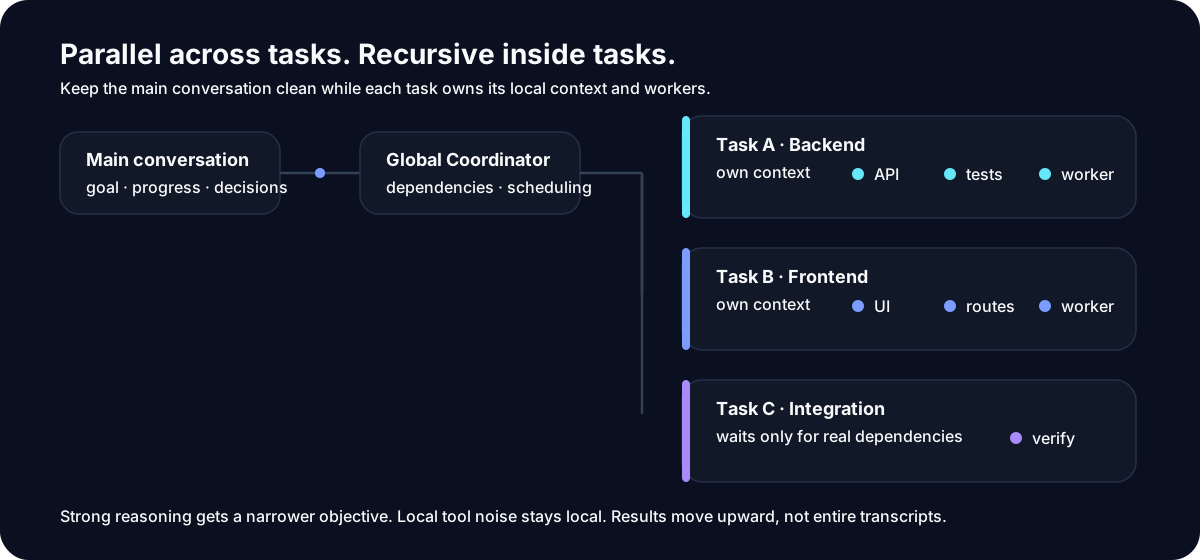
It turns the work into independent top-level tasks: run what can run in parallel, wait only on real dependencies, keep each task's context separate, and bring the results back together.
Each task can still use its own subagents, tools, Skills, or MCPs.
Parallel across tasks. Recursive inside tasks.
Small AI coding tasks are easy.
The hard part looks more like this:
“Refactor authentication end to end, including the backend, frontend, migration, tests, and documentation.”
At first, everything is fine.
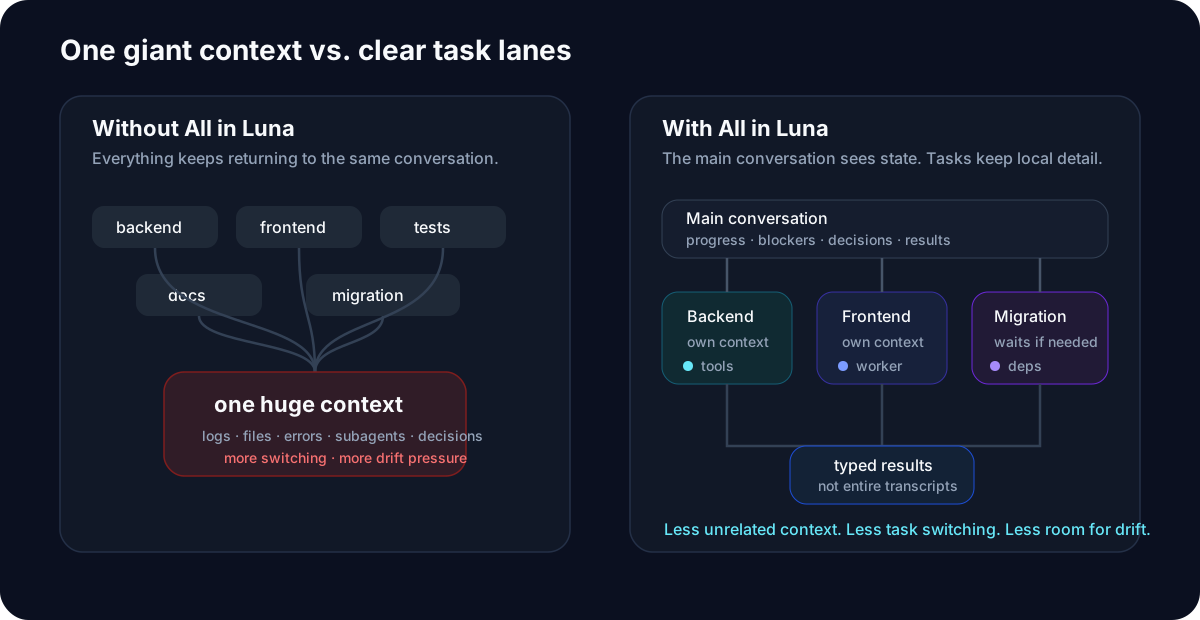
Then the agent reads files, edits code, runs tests, starts subagents, handles failures, reads more files, and keeps pushing more execution detail back into the same conversation.
After enough turns, familiar problems appear:
All in Luna starts from one simple idea: one conversation should not have to carry an entire project.
A typical agent workflow looks like this:
You
 │
 ▼
Main Agent
 ├─ subagent
 ├─ subagent
 └─ subagent
All in Luna adds a real Top-level Task layer above local workers:
You
 │
 ▼
All in Luna
 │
 ├─ Top-level Task A
 │    ├─ local work
 │    └─ subagents / tools / Skills
 │
 ├─ Top-level Task B
 │    ├─ local work
 │    └─ subagents / tools / MCPs
 │
 └─ Top-level Task C
      └─ waits only when it actually depends on A
A Top-level Task is not just another subagent.
It is an independent work domain with its own goal, context, dependencies, working state, local execution process, and result boundary.
A subagent is a local worker a Task may use when that Task needs to split its own work further.
All in Luna does not replace subagents. It gives them a better place to live.
A large goal can become independent work domains instead of temporary chat branches.
For example:
Add billing to this app

├─ Billing backend
├─ Checkout UI
├─ Database migration
├─ Integration tests
└─ Documentation
Each task can move independently, wait on dependencies, produce results, and keep its own working context.
Independent work does not need to queue behind unrelated work.
Billing backend       ● running
Checkout UI           ● running
Documentation         ● running
Database migration    ○ waiting for schema
Integration tests     ○ waiting for backend
One blocked task doesn't freeze unrelated work.
Backend debugging does not need to share one giant context with frontend changes, test logs, documentation, and release work.
Your main conversation should mostly see:
✓ what is done
● what is running
○ what is waiting
! what needs your decision
File reads, terminal output, test logs, diffs, and implementation detail can stay with the Task that produced them.
Your main conversation does not need to become the project's log file.
A Top-level Task can still split into WorkUnits or use local subagents when it is complex on its own.
Backend Task
 ├─ API
 ├─ database changes
 ├─ tests
 └─ migration checks
Local complexity stays local.
Parallel across tasks. Recursive inside tasks.
All in Luna persists run state, task state, dependencies, and results.
Long-running work does not have to remain attached to one ever-growing conversation.
start
→ work
→ stop
→ come back
→ resume
Completed work does not have to be rediscovered from chat history.
An agent saying:
“Done.”
is not the same as the task actually being complete.
All in Luna can check tests, builds, changed files, artifacts, and declared outputs before accepting a task as complete.
All in Luna is not one fixed workflow.
Use the default delivery path for ordinary software work.
Use GSD inside a Task when you want a more explicit development workflow.
Connect Research Routes for research-oriented work.
Tasks can also use other Skills, MCPs, tools, and host capabilities.
The Core runs complex work. It does not dictate how every task must think.
Suppose you say:
“Refactor this application's authentication system, including backend, frontend, migration, and tests.”
All in Luna can organize it as:
Authentication refactor

├─ Task 1 — Auth backend
│    ├─ session/token logic
│    ├─ API
│    └─ backend tests
│
├─ Task 2 — Frontend auth flow
│    ├─ login
│    ├─ logout
│    └─ protected routes
│
├─ Task 3 — Migration
│    └─ waits for auth contract
│
└─ Task 4 — Integration
     └─ waits for backend + frontend
Task 1 and Task 2 can move at the same time.
Task 1 can still use its own subagents if needed.
Task 3 waits only for the result it actually depends on.
You do not have to follow the complete implementation history of all four tasks in one conversation.
All in Luna is a good fit for:
If you are fixing one typo, explaining one function, changing one CSS rule, or doing another tiny linear task, using the current agent directly is usually faster.
All in Luna solves the organization problem of complex work. It does not make simple work complicated.
Most users do not need to choose a model policy first.
If you do not specify one, All in Luna uses resources available through the current environment, host, or deployment policy.
It does not require every user to use one fixed model or provider.
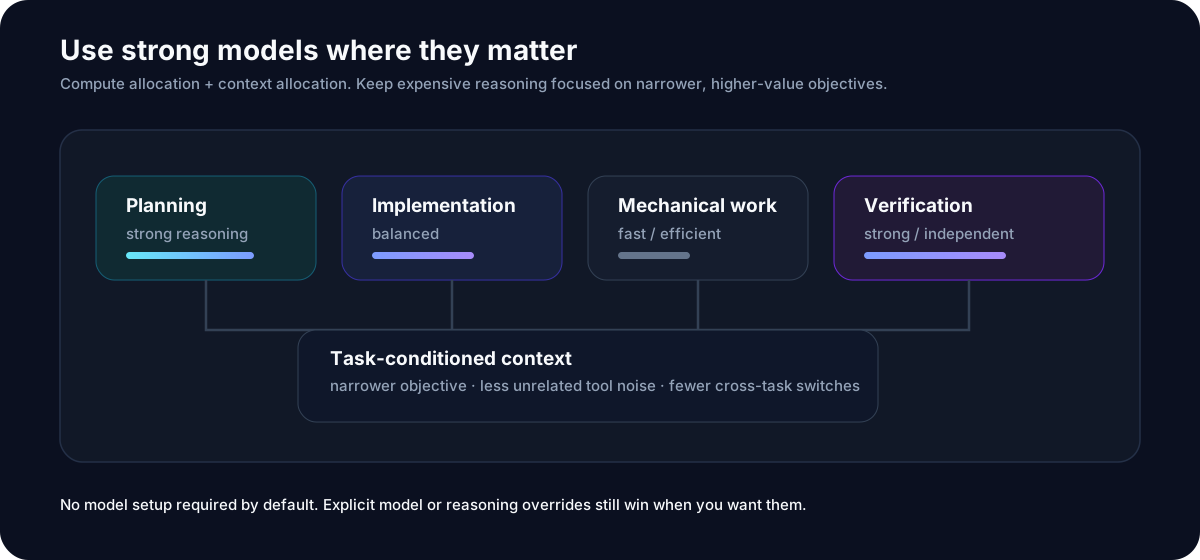
Different kinds of work do not always deserve the same amount of expensive reasoning.
For example:
Planning        → stronger reasoning
Implementation  → balanced
Mechanical work → fast / efficient
Verification    → strong / independent
Spend strong reasoning where it matters, not everywhere.
All in Luna also separates the problem itself. Strong models can work on narrower, more stable objectives with less unrelated context and fewer cross-task switches.
Less unrelated context. Less task switching. Less room for drift.
Common ways to use the resource system include:
These are usage patterns, not model names hard-coded into the Core. Advanced users can still override concrete models and reasoning at Task or WorkUnit scope.
See Models & performance.
The All in Luna Core is responsible for:
top-level tasks
dependencies
scheduling
context
results
recovery
A Workflow Pack can define how an individual Task should work.
The default software-delivery path for features, bug fixes, refactors, migrations, and integrations.
Use GSD when you want a more explicit development workflow:
clarify
→ specify
→ decompose
→ implement
→ verify
→ integrate
GSD and All in Luna operate at different layers.
GSD can run inside an All in Luna Top-level Task.
Preserves Claims, Evidence, unknowns, contradictions, experiments, and research route changes.
Research judgment does not automatically become implementation authorization.
| Subagents | GSD | All in Luna | |
|---|---|---|---|
| Split local work | ✓ | ✓ | ✓ |
| Detailed development workflow | — | ✓ | Optional |
| Independent top-level tasks | — | — | ✓ |
| Top-level dependency scheduling | — | — | ✓ |
| Separate context per top-level task | Limited | Phase-oriented | ✓ |
| Local workers inside each task | ✓ | ✓ | ✓ |
| Pluggable workflows | — | — | ✓ |
| Persistent run / recovery | Depends | Depends | ✓ |
The key difference is not who can create more agents.
All in Luna makes the Top-level Task itself a first-class runtime object.
Sol Advisor-style systems are closer to:
Strong Primary Architect
→ bounded implementation / review workers
All in Luna moves the orchestration boundary one level higher:
Global Coordinator
→ multiple persistent Top-level Tasks
→ each Task has its own workflow and workers
They focus on different abstraction layers rather than being simple substitutes.
After installing All in Luna, the simplest way to use it is just to say:
Use All in Luna to finish the authentication refactor.
Keep independent parts moving in parallel where possible.
That's it.
You do not need to design a TaskGraph, choose a scheduler, create an agent hierarchy, or fill in a resource questionnaire first.
When you want explicit control over a run:
python -m pip install "allinluna==2.0.0rc3"

allinluna start --goal "Finish the authentication refactor"
allinluna status RUN_ID
allinluna drive RUN_ID
See all commands:
allinluna --helpLane, direct-work, recovery, and diagnostic commands live in the advanced CLI documentation.
For repository development, replace the release install with python -m pip install -e ..
All in Flash is the DeepSeek Harness (DSH) bundle for All in Luna. It turns frozen All in Luna top-level task actions into durable DSH lane children, while preserving the exact action and receipt contract.
@zenx0x/allinflashplugins/deepseek-harness/README.mdAfter installing the All in Luna CLI, initialize a dedicated DSH profile in one command:
npx @zenx0x/allinflash@0.2.0 init --profile allinflash
dsh --profile allinflash
GitHub search terms: deepseek-harness, dsh, dsh-plugin, allinflash,
multi-agent-orchestration.
Starting a run does not grant All in Luna every external permission.
Permissions matter only when the corresponding action is actually reached, including:
Ordinary local exploration and task organization do not require a giant permission questionnaire up front.
Keep the Core small.
Top-level scheduling, context, protocols, and recovery belong in the Core. Specific workflows belong in Packs.
Protocols instead of management theater.
Correctness should come from runtime contracts where possible, not from adding another layer of Reviewer / Auditor / Manager agents.
Keep local complexity local.
A Task's tool noise and local workers should not pollute the whole project.
Stay model-neutral.
The Core describes the capability it needs instead of forcing every user onto one model.
Leave room for the user.
All in Luna runs complex work without silently expanding the user's goal.
See GitHub Releases and the Changelog for the current version, upgrade notes, and known limitations.
Apache License 2.0 — see LICENSE.
CLASSIFICATION EVIDENCE
系统优先读取 GitHub Topics,再与站内分类词典和词根规则比对。
ayanJava111
deepseek harness思考过程中文插件
ben7am1n
Durable cross-session SQLite memory for DeepSeek Harness
chenkezhen480
为deepseek-harness添加向量化跨会话记忆插件