开发工具
插件
dsh-doctor
asdf17128
Find what your DeepSeek Harness (dsh) patches silently broke — dead patches, config fields dropped by whole-config repla…
agentclicordisdeepseek
PROJECT TOPICS
PROJECT README


A plugin for DeepSeek Harness (dsh web GUI) that watches what the agent creates and downloads during a session, and shows it in a right-side popup panel — like the file viewer in Codex.
When a file or image is written to disk during a session, the panel pops up automatically on the right. Every row lets you:
explorer.exe /select on Windows, open -R on macOS, xdg-open on Linux).host.openPath RPC).Also ships a workspace folder shortcut at the bottom of the panel.
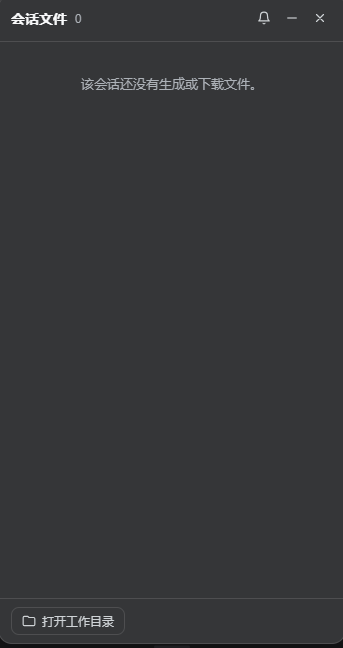
The right-docked session files panel: every row previews, opens, reveals, or copies its path; the bottom button opens the session's working directory. The panel is fully draggable (grab the header) and resizable from its left and bottom edges, with scrollbars appearing when it gets narrow.
Requires DeepSeek Harness dsh CLI (npm package @deepseek-ai/dsh) and pnpm.
cd dsh-file-panel
npm install          # installs esbuild (dev-only)
npm run build        # produces lib/index.js + lib/client.js (committed)

# register in the web profile (link: tracks your checkout live)
dsh plugin --profile web add link:.dsh plugin --profile web add github:yu2025-luo/dsh-file-panelThe built artifacts are committed, so no build step runs during install.
Restart the dsh web server (plugin sets take effect on restart), then refresh
http://127.0.0.1:3080. That's it — no configuration required.
Remove with:
dsh plugin --profile web remove dsh-file-panel| Gesture | Result |
|---|---|
| Agent creates/downloads a file | Panel pops up automatically (newest files carry a NEW chip) |
| Click a row | Inline preview (image / text / metadata) |
| Row hover actions | Preview, open, show in folder, copy path |
| 🔔 bell | Toggle auto-pop for new files |
– / × |
Collapse to a floating launcher button (with new-file badge) or hide |
| Bottom "open workspace folder" | Opens the session's working directory |
Panel state (open/collapsed) and the auto-pop preference persist in
localStorage. The auto-pop baseline is per session: files that already
existed when the panel first saw the session do not re-trigger a popup.
One npm package with two halves, registered as a single loader row
(cordis.patch.yml → row file-panel):
Host half (src/index.js)                     Browser half (src/client.jsx)
────────────────────────                     ──────────────────────────────
ctx.on('fs/observed')          ──┐
  write/edit tools report        │            shell.overlay slot entry:
  files (precise, attributed     │            a right-docked floating panel
  to the session)                ├──▶ FileTracker (per-session lists,
recursive fs.watch per           │      ignore rules, caps, fence)
  session working directory       │                │
  (catches shell downloads:    ──┘                ▼
  curl, Invoke-WebRequest, …)          RPC channel /file-panel
                                        authority: 'loopback'
                                        list · readText · readImage
                                        reveal · describe
                                                  ▲
                                                  │ poll every 1.5 s
                                        client: ctx.connection.rpc.call()
                                        open file: built-in api.host.openPath
The client half registers into the shipped shell.overlay slot (additive,
frame-wide floating layer), reads the current session through the standard
useSessions prop, and polls the plugin's own loopback-only RPC channel.
The channel is registered with ctx.connection.rpc.handle, the sanctioned
static-package RPC seam.
/file-panel channel is registered with authority: 'loopback', so
only pages served from 127.0.0.1 can call it. When the GUI is accessed
over the network (--trusted-host), the panel shows a notice and stays
inactive.src/
index.js host half: tracker wiring + /file-panel RPC endpoints
tracker.js pure-Node file tracker (fs/observed ingestion, recursive
watcher with debounce, ignore rules, caps, RPC fence)
client.jsx browser half: the right-side panel UI (React, JSX)
build.mjs esbuild build for both halves
cordis.patch.yml the bundle patch inserting the loader row
tests/ node:test unit + host-half smoke tests
lib/ built artifacts (committed, so installs need no build step)npm install
npm run build # rebuild lib/index.js and lib/client.js
npm test # node --testFor a fast client-side iteration loop after changing src/client.jsx:
npm run buildthen hard-refresh the GUI page (lib/client.js is served with
cache-control: no-cache; plugin sets only change on restart, but bundle
content re-hashes per request — see dsh-client-modules). During active
UI development you can also run pnpm run dev:web from the harness checkout
to rebuild client bundles on change.
Built against the public seams of @deepseek-ai/dsh 0.1.0-rc.x:
ctx.connection.rpc.handle / ctx.on('fs/observed')shell.overlay slot, useSessions standard prop,
ctx.connection.rpc.call, ctx.localeDeepSeek Harness is pre-release: those seams may move. If the panel stops
working after a dsh upgrade, check the pinned version in
package.json and re-run the build.
fs.watch({ recursive: true }) (Node ≥ 20).
On platforms where that is unavailable, the panel still tracks everything
the harness write/edit tools produce, but shell-side downloads may be
missed.node_modules, .git, and temporary-file noise are ignored by design.reveal on headless Linux reports canReveal: false and hides the
button (no desktop to open).Create a GitHub repo and push (the repo is already a git repository with
a v0.1.4 tag):
git remote add origin https://github.com/yu2025-luo/dsh-file-panel.git
git push -u origin main --tags
Add the dsh-plugin topic on the
repo page (About → gear icon → Topics) together with
deepseek-harness, dsh, deepseek, and file-preview. The repo then
appears on the public plugin topic page automatically.
Users install with
dsh plugin --profile web add github:yu2025-luo/dsh-file-panel#v0.1.4.
Optionally publish to npm (npm publish) — then install with
dsh plugin --profile web add dsh-file-panel.
Community catalogs that sync from the dsh-plugin topic:
Oh-My-DSH (auto-synced) and
awesome-deepseek-harness
(PR-based).
Remember to bump the version and re-run npm run build before releasing.
CLASSIFICATION EVIDENCE
系统优先读取 GitHub Topics,再与站内分类词典和词根规则比对。
asdf17128
Find what your DeepSeek Harness (dsh) patches silently broke — dead patches, config fields dropped by whole-config repla…
asdf17128
Manage DeepSeek Harness profiles — list, create, clone, diff, and share a whole dsh setup as one portable file.
aust24lzy
DeepSeek Harness (DSH) 开源插件导航站 —— 实时同步 dsh-plugin 生态,按 Stars 动态排行