开发工具
插件
dsh-doctor
asdf17128
Find what your DeepSeek Harness (dsh) patches silently broke — dead patches, config fields dropped by whole-config repla…
agentclicordisdeepseek
PROJECT TOPICS
PROJECT README
A minimal terminal coding agent harness in Go — a sibling to Pi.
mcp_list / mcp_inspect / mcp_call) to discover and call on demand. Same Gate / Ask / Hooks path as built-in tools. See MCP


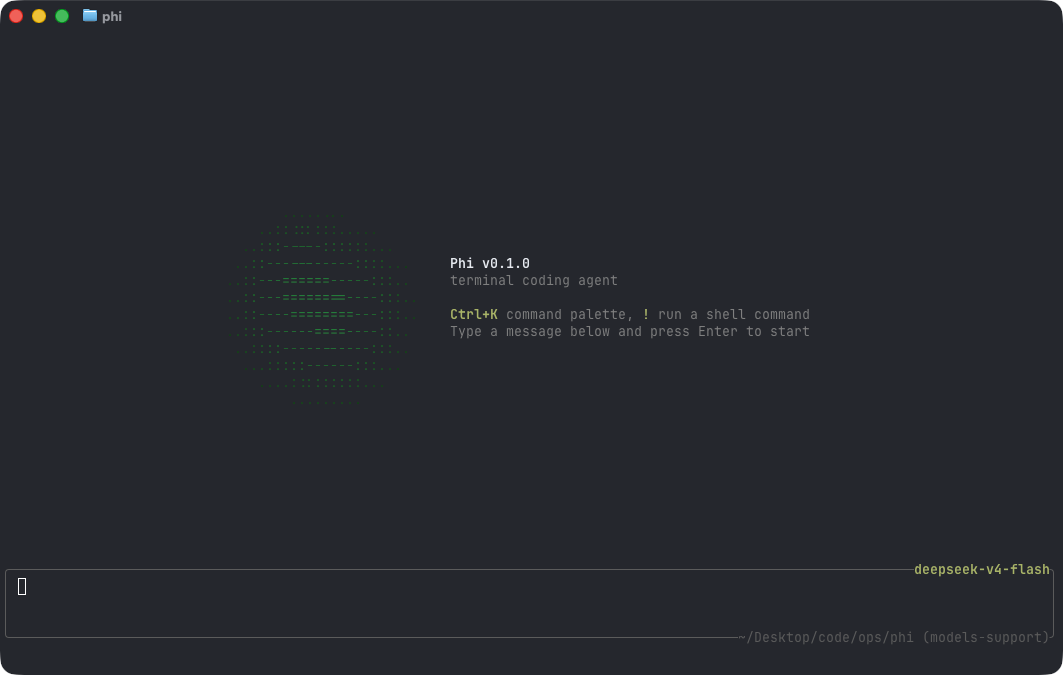
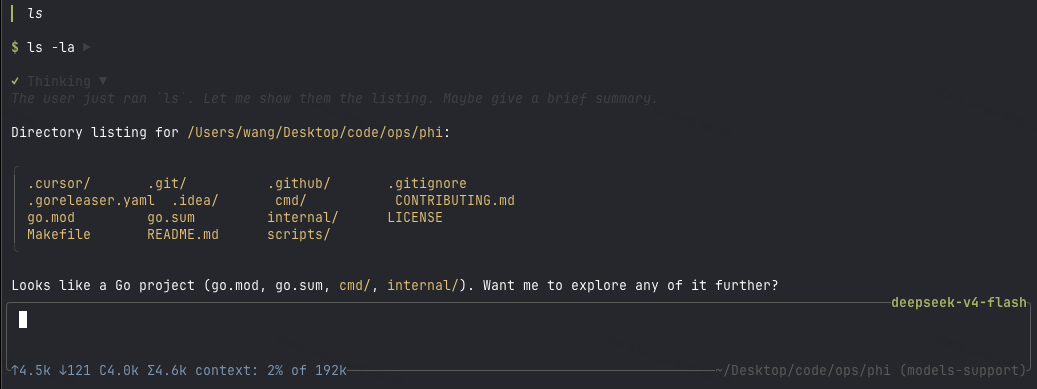
Install the latest release (macOS / Linux):
curl -fsSL https://raw.githubusercontent.com/pulseaiclub/phi/main/scripts/install.sh | bashWindows (PowerShell 5.1+):
irm https://raw.githubusercontent.com/pulseaiclub/phi/main/scripts/install.ps1 | iexFirst launch needs a model. Open the config editor (creates ~/.phi layout
and writes ~/.phi/config.yaml):
phi configOr set env vars for a one-off run:
export PHI_MODEL=gpt-4o
export PHI_API_KEY=sk-...
Then start the TUI:
phiOr build from source (Go 1.26.3+, see go.mod):
make build          # produces ./phi
make install        # build and install into $GOBIN
On first start, phi automatically creates ~/.phi/{bin,skills,hooks,session}. Search
tools (fd, rg) download into ~/.phi/bin in the background when missing.
The TUI gives the model four core tools — read, write, edit, and
bash — plus grep, glob, list, and fetch. The model uses these to
fulfill your requests.
phi aims to stay cheap to run and cheap to hack on. Numbers below are for a
stripped release build (CGO_ENABLED=0, -ldflags="-s -w"), measured on
macOS arm64 unless noted.
| Metric | phi |
|---|---|
| Release binary | ~12 MB |
| Idle RSS (1 session) | ~21 MB |
| 10 idle sessions (total RSS) | ~196 MB (~20 MB each) |
| Time to first frame | ~40 ms (27–65 ms) |
Cold go build (empty GOCACHE) |
~5.5 s |
| Warm rebuild | ~0.7 s |
| Go source (excl. tests) | ~22k LOC / 107 files |
| Go packages | 32 |
| Direct module deps | 6 (15 modules total) |
| Linked runtimes | system libs only (no Node / Electron / Python) |
phi reads ~/.phi/config.yaml (standard YAML). Environment variables
override it for one-off runs. phi config opens an HTML editor for the same
file in your browser.
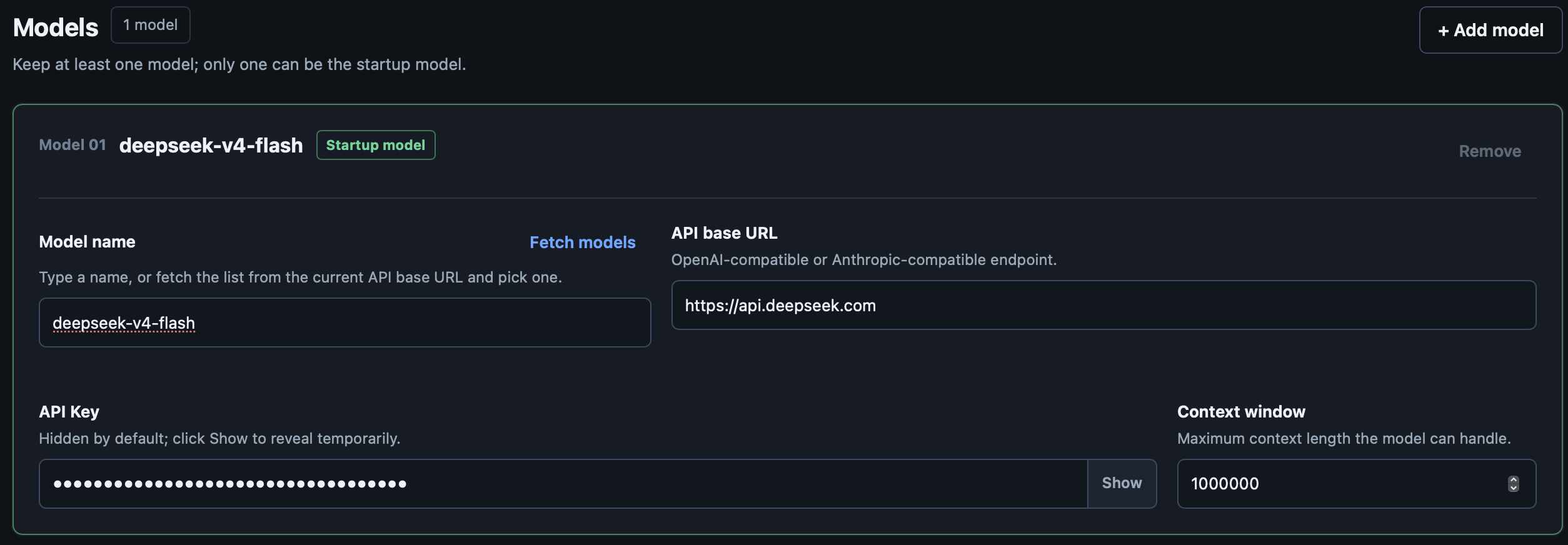
# ~/.phi/config.yaml
models:
  - name: gpt-4o            # model name; "claude-*" routes to the Anthropic API
    api_key: sk-...         # or set PHI_API_KEY
    base_url: https://api.openai.com/v1   # default; PHI_BASE_URL overrides
    context_window: 128000  # optional
    default: true           # the model used at startup; first entry wins if absent
  - name: claude-sonnet-4-20250514   # extra models; switchable at runtime
    api_key: sk-ant-...
    base_url: https://api.anthropic.com
    context_window: 200000

skill_path: ~/.phi/skills # where SKILL.md files are loaded from

agents:
  enabled: true           # default; set false to disable agent_* sub-agent tools

permissions:
  mode: interactive       # interactive | readonly | autopilot | headless-strict
  bash:
    default: ask          # ask | allow | deny
    allow:
      - "go test ./..."
    deny:
      - "rm -rf *"
  fetch:
    default: allow
    allowed_hosts:
      - "github.com"
Environment overrides:
| Variable | Overrides |
|---|---|
PHI_API_KEY |
models[].api_key (default model) |
PHI_MODEL |
models[].name (default model) |
PHI_BASE_URL |
models[].base_url (default model) |
PHI_SKILL_PATH |
skill_path |
Provider routing: a base URL containing anthropic or a model name starting
with claude uses the Anthropic Messages API; everything else uses the
OpenAI-compatible /chat/completions path.
~/.phi/
├── config.yaml   # global configuration
├── bin/          # downloaded search tools (fd, ripgrep)
├── skills/       # SKILL.md skill directories
├── hooks/        # tool-loop hook scripts (hook.json + run)
├── jobs/         # sub-agent job artifacts (meta, logs, result.md)
└── session/      # persisted sessions, one dir per working directory
└── <encoded-cwd>/phi (or phi tui) starts the TUI: a chat transcript on top, an editor at
the bottom, and a footer with the current activity. When a newer release is
available, the footer shows a hint like 0.2.0 available · phi update.
Assistant output is rendered as Markdown (CommonMark/GFM): headings, emphasis,
strikethrough, links, blockquotes, lists, task checkboxes, and tables are
styled with the active theme; fenced code blocks get a frame and per-language
syntax highlighting. Structural markers (#, `, *) are stripped.
The editor supports:
@ — fuzzy file mention picker (type @ and start typing a path)/ — slash command picker (/sessions, /resume, /clear)!command — run a shell command locally and stream its output into the
transcript (see Commands)Ctrl+K — command palette: settings → model / theme / permissions / agents, skills, hooks| Key | Action |
|---|---|
Ctrl+C |
Quit phi |
Esc |
Cancel the running agent / close pickers |
Ctrl+K |
Toggle the command palette |
Ctrl+Shift+C |
Copy the selected transcript text |
Themes: Dark, Darcula, Pink, and Terminal (default), switchable from
the palette under settings → theme.
| Command | Description |
|---|---|
phi / phi tui |
Start the interactive TUI |
phi run -p "…" |
Run one agent loop headlessly (see below) |
phi update |
Download and install the latest GitHub release |
phi update --check |
Query the latest release without installing |
phi sessions list |
List persisted sessions for this directory |
/sessions |
List sessions for this directory (TUI) |
/resume <id> |
Resume a session by id or unique prefix (TUI) |
/clear |
Start a fresh empty session (TUI) |
!command |
Run a shell command locally, stream output into the transcript; Esc cancels it |
In the TUI, !command runs locally via bash -c — outside the agent loop. It
doesn't count toward agent busy state, and the running command can be cancelled
with Esc without touching an in-flight agent turn.
Sessions persist automatically per working directory under
~/.phi/session/<encoded-cwd>/ as JSONL trajectories.
phi sessions list — list session id, mtime, and preview for the current
directory/sessions in the TUI — same, in-app/resume <id> — continue a session (id or unique prefix)/clear — start a fresh session (new id, empty transcript)phi run --session <id> / phi run --continue-last — resume headlesslyphi run -p "fix the failing test in internal/tools"Runs one agent loop without a TUI. Human logs go to stderr; with --jsonl,
machine-readable events go to stdout, one JSON object per line.
Flags:
| Flag | Description |
|---|---|
-p, --prompt STRING |
Prompt to run (required) |
--jsonl |
Emit JSONL events to stdout |
--max-rounds N |
Cap tool rounds (default 64) |
--timeout DURATION |
Limit the agent run wall-clock time (e.g. 10m; disabled by default) |
--session ID |
Resume a persisted session by id or unique prefix |
--continue-last |
Resume the newest persisted session for this directory |
--session-dir DIR |
Override the session storage directory |
Exit codes: 0 success · 1 runtime/LLM error · 2 max rounds reached ·
3 config/usage error.
In the interactive TUI, exhausting the tool-round budget prompts Continue /
Stop. Headless phi run has no confirmation UI, so it exits with code 2.
In headless mode, permission ask decisions are denied (there is no approval
UI), so readonly-style safety applies without extra flags.
Skills are directories containing a SKILL.md file with YAML frontmatter and
a Markdown body. They are loaded from ~/.phi/skills/ (or skill_path /
PHI_SKILL_PATH) and injected into the agent's context, letting you give the
model reusable procedures:
---
name: My Skill
 description: What this skill does
license: MIT
compatibility: claude, openai
---
Instructions the agent should follow when this skill is relevant.
In the TUI, add skills from the palette (skills → list), then submit the message with the selected skills applied.
Tool execution is gated by a permission policy, so the agent can run read-only
by default and ask before anything destructive. Configure it under
permissions: in ~/.phi/config.yaml.
Modes:
| Mode | Behavior |
|---|---|
interactive |
Default. ask decisions prompt in the TUI. |
readonly |
Deny writes / bash; read tools still work. |
autopilot |
Fold ask → allow, run unattended. |
headless-strict |
Fold ask → deny (used by phi run). |
Per-tool rules: bash.default / bash.allow / bash.deny (exact command
prefix matching) and fetch.default / fetch.allowed_hosts. Global keys:
workspace_only_writes (default true), ask_timeout_sec, and
dangerously_allow_all (default false).
In the TUI, an approval dialog replaces the editor with options to approve, deny with feedback, or allow all for the session / for every session. The palette's settings → permissions entry toggles session-wide bypass.
Hooks run custom logic around each tool call — before the permission gate and
after execution. Use them for organization policy, audit trails, or rewriting
tool input, without changing phi's binary or config.yaml.
Each hook is a directory containing a hook.json manifest and an executable:
{
  "name": "guard-bash",
  "event": "pre_tool",
  "match": "bash",
  "run": "./run.sh",
  "fail_closed": true
}
Hooks load from ~/.phi/hooks/ and <cwd>/.phi/hooks/; a project hook with
the same name replaces the user hook. In the TUI, list or reload them via
Ctrl+K → hooks. In readonly permission mode, only fail_closed hooks run
so slow audit hooks don't stall exploration. Full guide:
doc/hooks.md.
Configure 100 MCP servers. Pay ~0 schema tokens until you call one.
Most MCP hosts dump every tools/list schema into the model context before
you ask a question — browser stacks alone can burn 50k+ tokens. phi does not.
Instead the agent gets three meta-tools, and the system prompt lists configured server names (no schemas):
| Tool | Role |
|---|---|
mcp_list |
List servers, or tool names on one server (compact text) |
mcp_inspect |
Fetch a slim parameter summary for one tool |
mcp_call |
Run server + tool + args |
Flow: pick a server from the prompt → mcp_list(server=…) → mcp_inspect → mcp_call. Subprocesses start lazily on first use.
Calls still go through PreHooks → Gate / Ask → Run → PostHooks.
phi mcp add browsermcp -- npx @browsermcp/mcp@latest
phi mcp doctor
# In the TUI, the model can use configured servers without guessing MCP exists
Config: ~/.phi/mcp.json (project <cwd>/.phi/mcp.json overrides by name).
Disable with PHI_MCP=off. Stdio and HTTP in v1.
Full guide: doc/mcp.md.
Sub-agent tools (agent_spawn, agent_task, …) are on by default. To
keep a session lean, disable them in ~/.phi/config.yaml:
agents:
  enabled: false
Or toggle for the current session via the palette: settings → agents. When disabled, those tools are not registered and the model cannot spawn jobs.
Sub-agents themselves use a role (explore default | review | worker):
| Role | Tools | Use for |
|---|---|---|
explore |
read-only (+ allowlisted bash) | Search / map structure |
review |
read-only (+ allowlisted bash) | Diffs / checks; no edits |
worker |
full tools except nesting | Planned, independent edits |
Default stays explore (read-only). Prefer worker only after the parent has a concrete plan.
Built-in tools the model can call (see internal/tools/):
| Tool | Purpose |
|---|---|
bash |
Run a shell command in the working directory |
read |
Read a file |
write |
Write a file (gated by permissions) |
edit |
Targeted edit of a file |
grep |
Regex search across files |
glob |
File patterns |
list |
Directory listing |
fetch |
HTTP fetch (host-gated by permissions) |
agent_spawn |
Start an isolated sub-agent job (async) |
agent_task |
Spawn + wait for one sub-agent summary |
agent_wait |
Wait for a job; returns short summary only |
agent_list |
List jobs |
agent_log |
Tail a job's event log |
agent_cancel |
Cancel a running job |
Sub-agent transcripts live under ~/.phi/jobs/<id>/ and are not injected
into the parent context — only the wait/task summary is.
Fast search tools (fd, ripgrep) are downloaded on first startup into
~/.phi/bin when missing.
See Project layout for the source tree map.
See CONTRIBUTING.md for development setup, code style, and commit conventions.
CLASSIFICATION EVIDENCE
系统优先读取 GitHub Topics,再与站内分类词典和词根规则比对。
asdf17128
Find what your DeepSeek Harness (dsh) patches silently broke — dead patches, config fields dropped by whole-config repla…
asdf17128
Manage DeepSeek Harness profiles — list, create, clone, diff, and share a whole dsh setup as one portable file.
aust24lzy
DeepSeek Harness (DSH) 开源插件导航站 —— 实时同步 dsh-plugin 生态,按 Stars 动态排行