其他
技能
dsh-web-search-ddg
aooyoo
Zero-token DuckDuckGo search provider for the DeepSeek Harness (DSH) web seam — local headless browser, no API key, no m…
deepseek-harnessdeepseek-harness-plugindsh-bundledsh-ctest
PROJECT TOPICS
PROJECT README





dsh-mobile-gui-agent is an installable DeepSeek Harness plugin for controlling Android devices through ADB. It adds a mobile_gui_agent entry to the Harness Web UI and drives every task through an observe → decide → act → verify loop.
The repository is a single publishable npm package. The bundle patch inserts one Cordis plugin row; that plugin composes the ADB Provider, the Phone Agent Consumer, the Phone tools, the Typert Remote adapter, and the browser client under one lifecycle.
Connect and authorize an Android device, then install the pinned release into the Harness Web profile:
adb devices -l
dsh plugin --profile web add github:kunjinkao-os/dsh-mobile-gui-agent#v0.2.0
dsh --profile web --dump-config
dsh --profile web
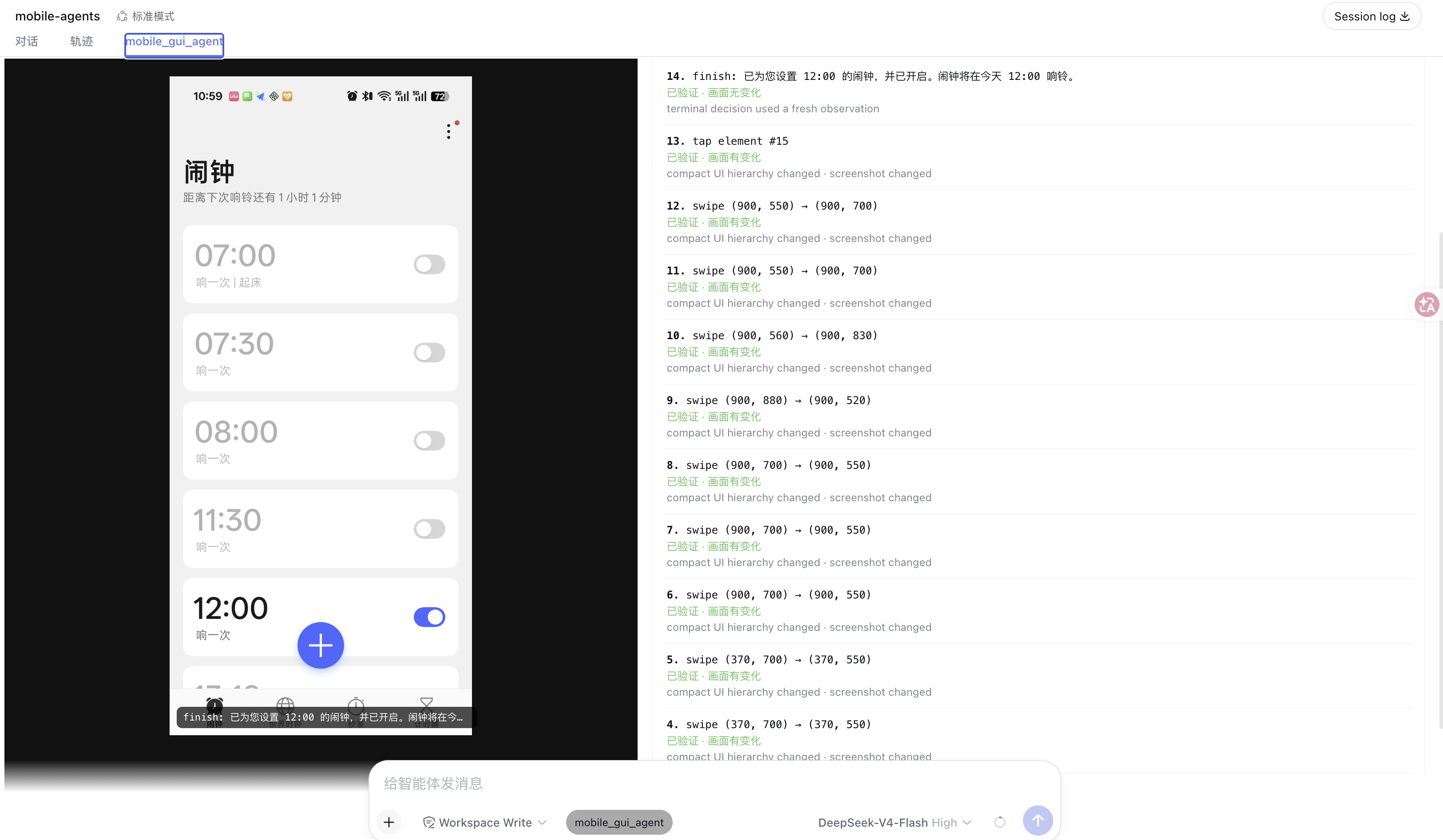
The device row must report device. The configuration dump must contain a # == dsh-mobile-gui-agent layer and one dsh-mobile-gui-agent row. For the clearest workflow, send one short ordinary message in the Harness conversation first, then select mobile_gui_agent and enter the real phone command in its Task field. Do not enter the phone command in the ordinary Harness conversation composer. See Requirements and Use before operating an account or a device containing personal data.
Prepare a mobile task.The blank-session toolbar launcher is also available, but the flow above makes the separation between Harness conversation messages and phone tasks explicit.
^0.1.0-rc.547f943859bef60e4160492346772ded9b24f765a0.1.0-rc.6 Harness packages^22.19.0 || >=24.0.0adb devicesThe package follows the upstream dsh.bundle.patch and dsh.client manifests. It does not patch the Harness Agent loop or require unpublished Phone packages.
phone_observe and phone_act Harness toolsThis plugin does not install an Android accessibility service. It combines ADB screenshots with the hierarchy produced by Android UIAutomator. Custom Canvas, WebView, game, and image-only controls may be visible in the screenshot even when they are absent from the hierarchy; the Agent can use vision-capable model input or an optional PhoneVisionProvider for those screens.
Install Android Platform Tools and confirm adb version works.
Enable Developer options and USB debugging on the Android device.
Authorize the computer when Android shows the RSA debugging prompt.
Confirm the device is usable:
adb devices -lThe selected row must report device, not offline or unauthorized.
Use a DeepSeek Harness Web profile. The mobile_gui_agent entry is a browser client contribution and therefore is not shown by a headless-only profile.
Root access and an APK installed on the phone are not required for observation, navigation, or printable ASCII input. Unicode input uses the external ADB Keyboard helper (com.android.adbkeyboard/.AdbIME). When that helper is installed, the plugin discovers it even if it is disabled, enables and selects it only for the Unicode operation, then restores the user's previous IME and enabled set. No model setup action or user interaction is needed. If the helper is truly absent, configure an absolute host path to a reviewed APK with adb.unicodeImeApkPath; the plugin never downloads an APK, and installation still requires explicit Harness approval.
To install a local checkout into the standard Web profile:
dsh plugin --profile web add ./dsh-mobile-gui-agent
dsh --profile web --dump-config
dsh --profile web
When running Harness from its source checkout, use pnpm dsh in place of dsh:
pnpm dsh plugin --profile web add ../dsh-mobile-gui-agent
pnpm dsh --profile web --dump-config
pnpm dsh --profile web
The dump must contain a # == dsh-mobile-gui-agent layer and one row named dsh-mobile-gui-agent. Open the Web UI and select a workspace. The blank-session toolbar launcher can open the task panel immediately. For the recommended workflow, first send a short ordinary message to create a nonblank conversation, then select the regular mobile_gui_agent tab and enter the phone task there.
Built lib/ artifacts are tracked so a pinned Git checkout can be installed without allowing a dependency build script:
dsh plugin --profile web add github:kunjinkao-os/dsh-mobile-gui-agent#v0.2.0For an immutable review target, replace the release tag with its commit SHA. A release tarball can also be installed without a Git build step:
dsh plugin --profile web add ./dsh-mobile-gui-agent-0.2.0.tgzPin a reviewed tag or commit when installing a plugin that can control a real device.
Pair the phone with the Android Platform Tools when the Android version requires pairing, then either connect before starting Harness:
adb connect DEVICE_IP:PORT
adb devices -l
or enter DEVICE_IP:PORT in the mobile_gui_agent panel and select Connect. The computer and Android device must be able to reach each other, and the wireless debugging port may change after Android restarts wireless debugging.
Open a Harness conversation and send a short initialization message, for example Prepare a mobile task.
Select the mobile_gui_agent conversation tab. The blank-session toolbar launcher remains available as an alternative.
Select a connected device and refresh the screenshot.
Enter the actual phone task in the Task field inside mobile_gui_agent, not in the ordinary Harness conversation composer. For example:
Open Settings and go to the Wi-Fi pageSelect Start. Use Pause, Resume, or Stop when needed.
Answer approval prompts in the standard Harness approval UI. The Agent stops before the consequential action until approval is granted once.
Other example tasks:
Open Android Settings
Open the browser and focus the address bar
Type hello world in the focused text field
Open WeChat, find File Transfer, and prepare to send “test123”
The last example requires approval before the semantic Send control is activated.
The bundle supplies safe defaults in cordis.patch.yml. Override the complete plugin row in the profile's cordis.patch.yml because Harness patch rows replace, rather than deep-merge, their config value.
- id: mobile-gui-agent
  name: dsh-mobile-gui-agent
  config:
    adb:
      adbPath: adb
      # unicodeImeApkPath: /absolute/path/to/reviewed/ADBKeyboard.apk
      commandTimeoutMs: 10000
      processGraceMs: 1000
      screenshotMaxBytes: 16777216
      hierarchyMaxBytes: 4194304
      diagnosticMaxBytes: 65536
      hierarchyMaxElements: 400
      hierarchyMaxSerializedBytes: 65536
      hierarchyAttempts: 3
      hierarchyRetryDelayMs: 300
      stablePollMs: 300
      stableSamples: 3
      stableTimeoutMs: 5000
      stableDifferenceThreshold: 0.01
    agent:
      maxSteps: 50
      taskTimeoutMs: 600000
      actionTimeoutMs: 30000
      maxConsecutiveFailures: 5
      stablePollMs: 300
      stableSamples: 3
      stableTimeoutMs: 5000
      stableDifferenceThreshold: 0.01
      approvalEnabled: true
      traceScreenshots: true
      maxTraceSteps: 100
commandTimeoutMs bounds one ADB subprocess. actionTimeoutMs bounds an entire action, including stabilization and the post-action observation. Keep actionTimeoutMs greater than commandTimeoutMs; slower wireless devices may need 30–60 seconds.
unicodeImeApkPath is optional and must be an absolute path on the Harness host. It is never accepted from the model. An already-installed helper is detected with Android's all-IME listing and used transparently: the plugin temporarily enables/selects it as needed, broadcasts the text, and restores the previous input method and enabled state. When the helper is absent and an APK path is configured, the Agent can call setup_unicode_input; Harness shows a mandatory one-shot approval before installation. Review the APK source and license before configuring it; the plugin does not bundle or download ADBKeyBoard.
maxTraceSteps bounds the live and terminal GUI step list. maxSteps and taskTimeoutMs bound a run. Screenshot and hierarchy byte limits prevent unbounded ADB output. Model-visible screenshots use the Harness attachment store when the selected model accepts images.
dsh.bundle patch
└── dsh-mobile-gui-agent (one Cordis Loader row)
    ├── AdbPhoneDeviceRegistry       provides ctx.phone
    ├── PhoneAgentService            provides ctx.phoneRuns
    │   └── Agent-scoped tools       phone_observe + phone_act
    └── PhoneAgentRemote             Typert Host namespace

dsh.client browser contribution
├── mounts generated phoneAgent Typert Remote descriptors
├── registers the mobile_gui_agent conversation view
└── registers the blank-session mobile_gui_agent launcher
The existing Harness Agent owns planning and turn execution. Starting a Phone run installs only Agent-scoped Phone tools and the dedicated Phone system prompt. Each phone_act performs a fresh pre-action capture, validates the strict action, resolves semantic element bounds, requests approval if needed, executes through PhoneDevice, waits for a stable screen, captures again, verifies the result, and returns the new observation to the same Agent loop.
The compact hierarchy removes invisible and meaningless containers, prioritizes text and interactive nodes, assigns short IDs, and enforces element and serialized-byte limits. A tap_element action also carries the observation ID. Before execution, the plugin revalidates the selected element's resource ID, class, content description, and bounds; unrelated animation can continue, but a moved, missing, changed, or ambiguous target is rejected as stale.
Starting a run adds the dedicated Phone prompt and two Agent-scoped tools to the existing Harness Agent. phone_observe returns the foreground app, activity, compact hierarchy, screenshot attachment when supported, recent verified steps, and failure context. phone_act accepts one strict action and always returns a fresh post-action observation. The model never receives raw UIAutomator XML or arbitrary ADB shell access.
The prompt prefix is stable for a run, while each compact observation changes with the phone screen. Element and serialized-byte limits cap hierarchy growth; screenshot attachments are used only when the selected model accepts image input. Text-only models can still operate hierarchy-backed controls but cannot reliably reason about image-only UI without a PhoneVisionProvider.
PhoneShellRequest classification.approvalEnabled is true.Report security issues according to SECURITY.md.
adb.unicodeImeApkPath and explicit approval.pnpm install
pnpm run typecheck
pnpm run build
pnpm run test
pnpm run verify:package
pnpm packThe regular suite uses FakePhoneDevice. The real ADB integration suite automatically skips unless a device serial is supplied. Run its read-only screenshot and hierarchy check with:
DSH_PHONE_ADB_INTEGRATION_DEVICE=emulator-5554 pnpm run test:adbMutation checks are separately opt-in:
DSH_PHONE_ADB_INTEGRATION_DEVICE=emulator-5554 DSH_PHONE_ADB_MUTATION_TESTS=1 pnpm run test:adbThe mutation check can press Home, Back, tap, swipe, and enter text on the selected device. Use it only on a device where those actions are safe.
mobile_gui_agent entry is missingConfirm the plugin was added to the same Web profile you started, inspect --dump-config, and hard-refresh the browser after installation. A headless profile has no browser conversation views. On the empty new-conversation hero, the regular tab strip remains hidden by Harness, but the plugin's mobile_gui_agent button should appear in the composer toolbar after a workspace is selected; use it to open the task panel directly.
device unauthorizedUnlock the phone, accept the RSA prompt, then run adb kill-server, adb start-server, and adb devices -l. Revoke USB debugging authorizations on Android if the prompt no longer appears.
exec-out screencap -p timed outWireless ADB may be slow or disconnected. Run adb -s DEVICE exec-out screencap -p > /tmp/phone.png manually, reconnect the endpoint, keep the screen unlocked, and raise both adb.commandTimeoutMs and agent.actionTimeoutMs. The plugin reports the timeout as a recoverable action result instead of assuming the click succeeded.
UIAutomator does not expose every Canvas, WebView, game, or custom-rendered control. Use a vision-capable model, refresh the screenshot, scroll, close overlays, or provide a PhoneVisionProvider plugin.
ADB text input is most reliable with a focused ordinary text field. Printable ASCII uses Android's native input text. Unicode uses UTF-8 Base64 broadcasts through ADB Keyboard (com.android.adbkeyboard/.AdbIME). Check the current state with:
adb shell ime list -s
adb shell settings get secure enabled_input_methods
adb shell settings get secure default_input_method
The provider checks installation with ime list -a -s, rather than mistaking a disabled IME for an absent package. If ADB Keyboard is installed, input_text and replace_text temporarily enable/select it as needed and restore the exact previous IME state after the broadcast, including cancellation cleanup. If the helper is absent, set adb.unicodeImeApkPath to an absolute path for an APK you have reviewed. The Agent then calls setup_unicode_input, which cannot bypass Harness approval and installs only when necessary. If no path is configured, setup returns PHONE_UNICODE_INPUT_UNSUPPORTED and the Agent stops instead of retrying. replace_text updates a focused field in one verified step rather than repeatedly pressing Delete.
The repository uses the dsh-plugin topic so DSH community catalogs can discover it.
CLASSIFICATION EVIDENCE
系统优先读取 GitHub Topics,再与站内分类词典和词根规则比对。
aooyoo
Zero-token DuckDuckGo search provider for the DeepSeek Harness (DSH) web seam — local headless browser, no API key, no m…
awa-123-cw
DSH 图片/音视频托管插件:自动拉起 8899 静态服务 + 3080 /files/ 路由(HTTP Range 流式)+ WebUI 内点击即播(视频静音/音频 20% 音量/互斥懒加载)
awa-123-cw
DSH 设置页「关于」栏位 + 一键检测更新插件(About page with update checking for DeepSeek Harness WebUI)