


部署运维
插件
dsh-webui-perf
awa-123-cw
DeepSeek Harness WebUI 性能优化开关插件:长代码流式渲染/历史加载/高亮缓存优化,设置面板一键开关(with official-package patches)
deepseek-harnessdshdsh-pluginperformance
PROJECT TOPICS
PROJECT README
dsh-meterEnglish | 中文 DeepSeek bills by time of day now. This is the meter for it.Two peak windows a day, off-peak at half the peak rate. Cost stopped being a number you read afterwards and became a rate you are standing in. One line under the composer: what this session cost, which tariff is running, how long until it flips. Hover it for the tariff clock, the cache economics, and your balance.
|
|
dsh plugin --profile web add @dshworks/dsh-meter
dsh --profile web
dsh plugin forwards to pnpm, so pnpm must be on PATH. Nothing else to
configure: the meter appears under the composer as soon as a session bills
its first request.
2 turns · 2 steps | LLM 3.1s | TTFT avg 1.3s · 41 tok/s | Cache hit 50% | Input 44.3K tok
                    ¥0.0672  |  peak  |  off-peak in 48m
The harness's own stats line, untouched, and ours under it. This plugin adds a line — it does not shadow the shipped one, which is what a cost plugin has to do to append to it.
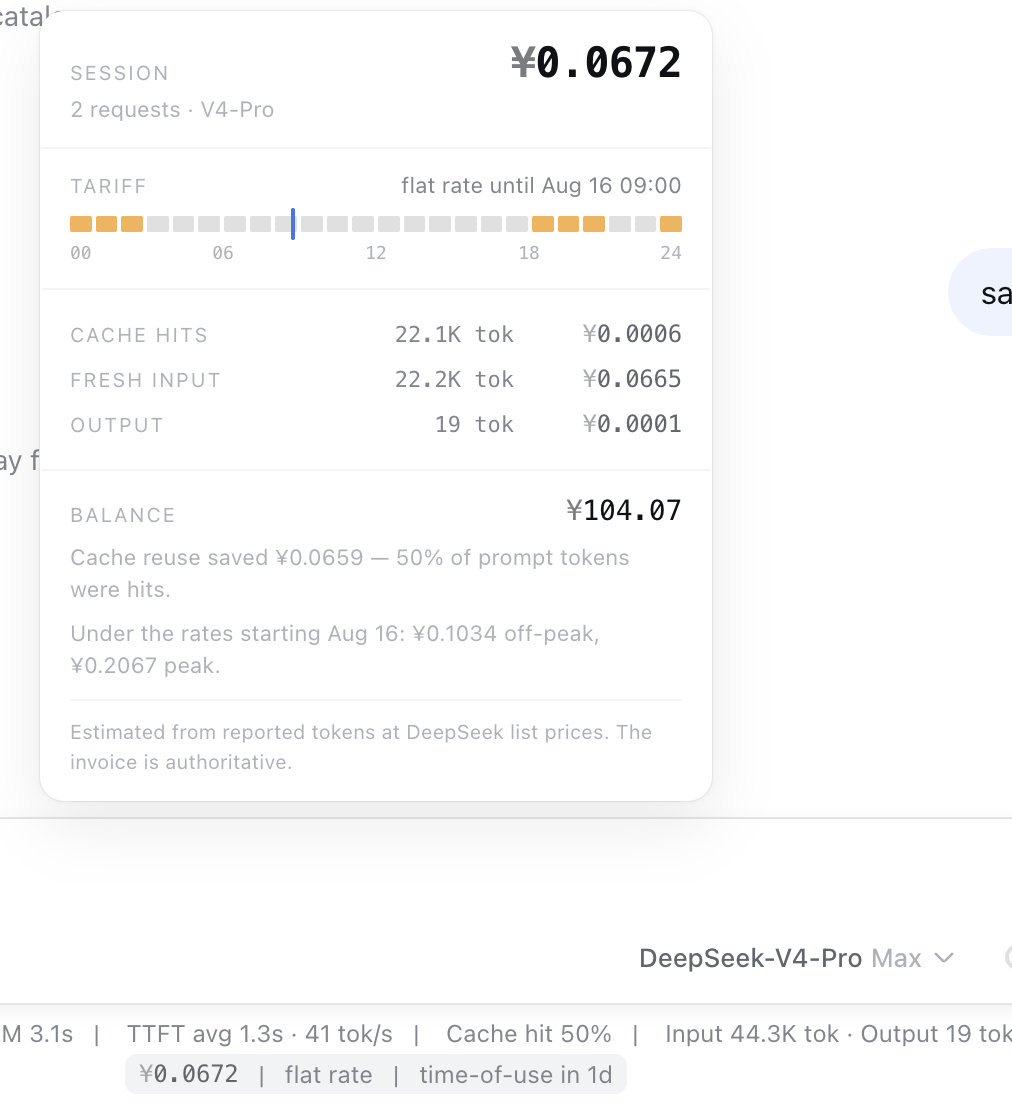
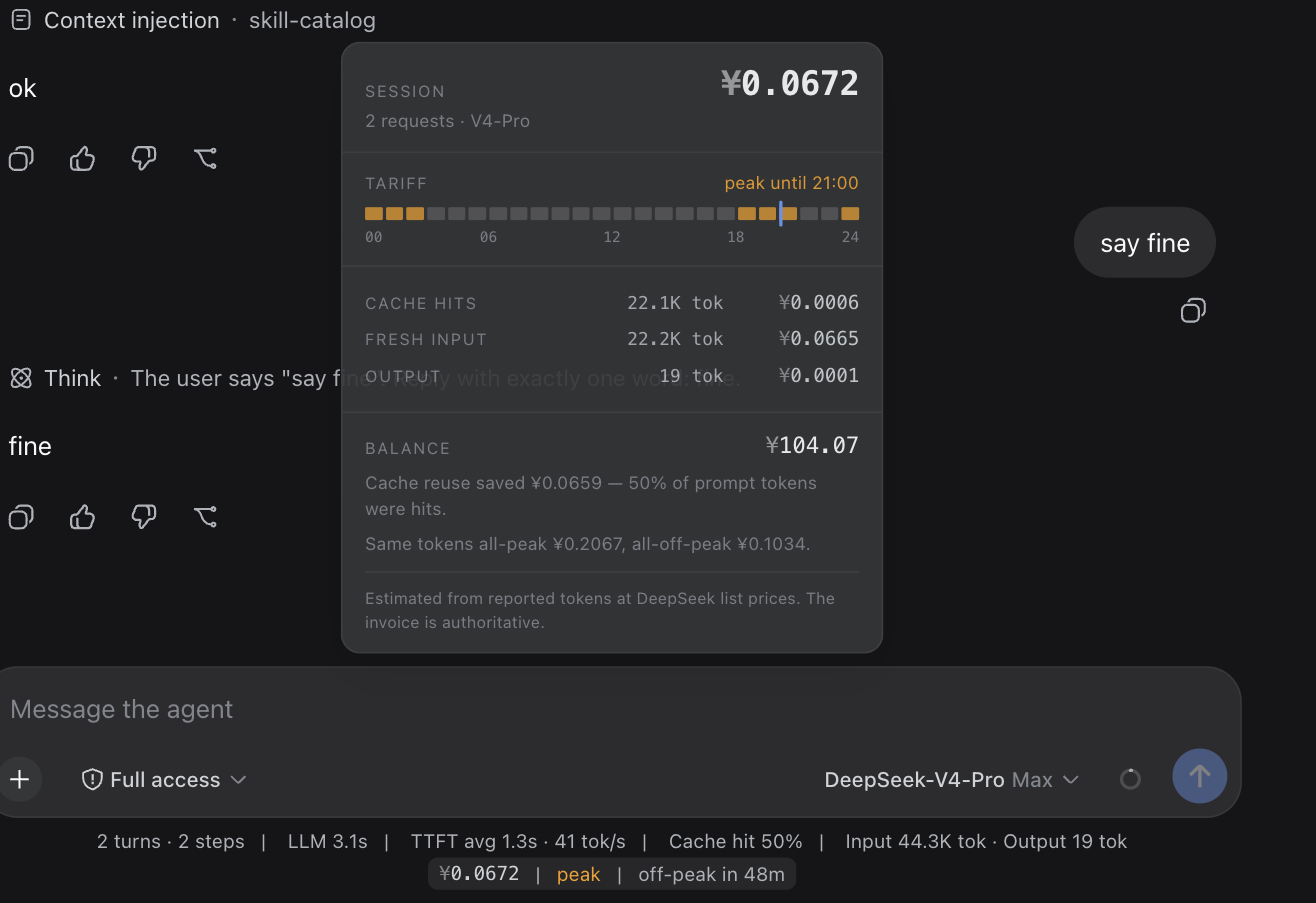
Hover or focus for the card. Inside a peak window the tariff is called out in amber and the countdown runs to the next off-peak hour:
| The card shows | Why it is there |
|---|---|
| The session total, request count, models | The number, once, at full size |
| A 24-hour tariff strip in your local time, with a live now-marker | Peak windows are published in UTC. Reading them off a strip beats doing timezone arithmetic at 11pm |
| cache hits / fresh input / output — tokens and money on each | A cache hit costs 1/50th of a miss. This is the row that shows whether your prompt prefix is stable |
| Your account balance, and how much of it is granted credit | Granted balance expires; topped-up balance does not |
| The same tokens priced under the other tariff | Before the switchover: what the new rates do to this session. After: what waiting for off-peak is worth |
| What the cache saved | The counterfactual where every hit had been a miss |
Live-verified against dsh 0.1.0-rc.6 on 2026-08-15, in a real web
session on DeepSeek-V4-Pro — not a mock:
| Claim | How it was checked |
|---|---|
| Loads in a stock web profile | dsh --profile web --dump-config lists it; /plugins/dsh-meter/client.js serves 200 |
| The readout is correct | 22.2K cache-miss input on v4-pro at the flat rate = ¥0.0665; the line and the card agree with the harness's own token counts |
| Survives a restart | Server restarted, session reopened cold — the projection replays from the durable log at the same figure |
| Both themes, both tariff states | Light and dark, flat and peak, captured above |
| Currency detection | A live account returns {"currency":"cny", ...} and the whole surface switches to ¥ with no configuration |
| 47 tests, CI green | pnpm test — the fold, the tariff clock, the rate card, the balance reader, and the generated-bundle sync check |
DeepSeek publishes two independent rate cards — USD for the international platform, CNY for the mainland one. An account is billed against exactly one of them, and neither table is a conversion of the other, so a plugin that picks with an exchange rate is wrong twice.
dsh-meter computes both and lets the account decide. GET /user/balance returns the currency the account is denominated in — a
live account lists both rows with only one funded — so the meter reads
the funded row and shows that side. Nothing to configure, nothing to
guess from your interface language.
The balance request runs on the host, keyed by the same credential seam
the LLM adapter uses; the browser gets parsed numbers over
GET /dsh-meter/balance and never the key. It fires when the meter
mounts and when you open the card, not on a schedule — set
balance: false to turn the whole thing off and the meter keeps working.
Carried verbatim in lib/core.js, per 1M tokens.
| cache hit | cache miss | output | |
|---|---|---|---|
| v4-flash flat (until Aug 16 16:00 UTC) | $0.0028 / ¥0.02 | $0.14 / ¥1 | $0.28 / ¥2 |
| v4-flash off-peak | $0.007 / ¥0.05 | $0.22 / ¥1.5 | $0.66 / ¥4.5 |
| v4-flash peak | $0.014 / ¥0.10 | $0.44 / ¥3 | $1.32 / ¥9 |
| v4-pro flat (until Aug 16 16:00 UTC) | $0.003625 / ¥0.025 | $0.435 / ¥3 | $0.87 / ¥6 |
| v4-pro off-peak | $0.022 / ¥0.15 | $0.66 / ¥4.5 | $1.98 / ¥13.5 |
| v4-pro peak | $0.044 / ¥0.30 | $1.32 / ¥9 | $3.96 / ¥27 |
Peak is 01:00–04:00 and 06:00–10:00 UTC (09:00–12:00 and 14:00–18:00 Beijing). Every other hour is off-peak, including the two-hour gap between the windows. Off-peak is exactly half of peak — and still above the flat rate it replaced, by about 2.4x on output.
Source: https://api-docs.deepseek.com/quick_start/pricing, fetched 2026-08-13.
| Behavior | Detail |
|---|---|
| Source of truth | Provider-reported token counts in the durable session log. Nothing is sampled or inferred |
| Tariff per request | Decided by dispatch time (step/start), not by when the answer finished. A request sent at 00:59 UTC is billed off-peak even if it streams into the peak window, and a session that spans a boundary is billed correctly on both sides |
| Billed buckets | inputTokens at the cache-MISS rate, cacheReadTokens at the cache-HIT rate, outputTokens at the output rate. The harness reports these disjoint (the DeepSeek adapter subtracts hits out of prompt_tokens), and reasoning tokens are already inside output |
| Cache writes | Folded into the miss bucket. DeepSeek publishes no separate write price and bills a first-time prompt at the miss rate; the DeepSeek adapter never reports one |
| Failed requests | A step's usage chunk is counted even when the request then fails; the finalized message REPLACES that sample rather than adding to it, including when the message names a different model than the request header did |
| Unknown models | Counted and named, never priced. A model with no published rate contributes tokens and requests to the readout and zero money, and the card says so |
| Durability | One session projection (costMeter), folded from the log. It survives paging, compaction, a reload, and a server restart, and rides the standard projection cache |
None. dsh-meter adds no tool, no system-prompt section, no message, and
no model call; it does not touch the request. Cost belongs to the person
paying, not to the agent's context window.
None — the plugin never participates in a request.
Everything below is a validated config field, set in your profile's
cordis.patch.yml:
- id: dsh-meter
  config:
    currency: cny        # pin a rate card instead of detecting it
balance: false # never call /user/balance| Key | Default | Meaning |
|---|---|---|
currency |
auto |
Which rate card to show: auto (the account's own balance currency, then the interface language), usd, or cny |
balance |
true |
Serve the account balance to the Web UI |
apiKeyEnv |
DEEPSEEK_API_KEY |
Credential reference holding the API key |
baseUrl |
https://api.deepseek.com |
Origin the balance is read from |
balanceTtlMs |
300000 |
Minimum age before a card opening refetches the balance |
balanceTimeoutMs |
4000 |
Per-request timeout for the balance read |
pnpm install
pnpm test                        # bundle-sync check, then vitest
node scripts/build-client.mjs    # regenerate lib/client.js after editing core/ui
lib/core.js holds the rate card, the tariff clock, and the fold.
lib/balance.js is the account reader. src/ui.js is the browser
surface. scripts/build-client.mjs inlines core + ui into
lib/client.js, the bundle the harness serves — so the price table
exists in exactly one file, and pnpm test fails if the generated bundle
drifts from it.
The dsh registry lists ~50 cost and usage
plugins;
several arrived the same week DeepSeek dated the switchover, and reading
them shaped this one. The cache-savings framing comes from
deepseek-cli's local
usage ledger.
MIT
CLASSIFICATION EVIDENCE
系统优先读取 GitHub Topics,再与站内分类词典和词根规则比对。
awa-123-cw
DeepSeek Harness WebUI 性能优化开关插件:长代码流式渲染/历史加载/高亮缓存优化,设置面板一键开关(with official-package patches)
caiyfa
deepseek-harness (dsh) 全局 Token 用量看板插件 —— 一行命令安装,后台常驻增量统计全部会话:按模型/按时间/按会话的用量趋势(分钟·小时·天 × 柱状/堆叠/累计)、红绿异常时点标记与按会话异常分组,子代理消…
gordonlu
Request Context Profiler for DeepSeek Harness — see what changed between model requests, and how cache reuse changed wit…