
消息通讯
渠道适配
dsh-notify
baka-world
DeepSeek Harness desktop notification plugin (notify-send / D-Bus)
cordisdbusdeepseek-harnessdesktop-notification
PROJECT TOPICS
PROJECT README


A multi-platform IM gateway plugin for DeepSeek Harness (dsh): connect your dsh agent to Feishu (Lark), WeCom (WeChat Work), and Telegram, and chat with it from the messaging apps you already use.
One agent per chat. Multi-turn context. Whitelist access control. Idle reaping. No public endpoint required (Feishu long connection / Telegram long polling; WeCom uses an HTTP callback).
/callback/ws/endpoint + protobuf frames, client-driven ping keepalive, 3s event ACK, message-id dedup), or webhook mode. No public URL needed for the default mode. The same adapter also serves the international Lark edition (open.larksuite.com) via adapters.lark.WXBizMsgCrypt AES-256-CBC decryption and SHA1 signature verification, plus active replies via the messaging API.getUpdates), automatic message splitting at the 4096-char limit.allowedUserIds) on every adapter; empty means everyone — set it in production./help, /reset, /status, /model.# From npm (recommended):
dsh plugin --profile im add dsh-im-hub
# From a Git repo or a local checkout (development):
dsh plugin --profile im add link:D:/projects/dsh-im-hubThis creates a headless profile im whose bundles are @deepseek-ai/dsh-base + dsh-im-hub. Boot it with:
dsh --profile imWhen the plugin runs inside the Web GUI (dsh web profile), a visual
configuration card appears at Settings → Plugins → Configurable plugins →
IM Gateway (dsh-im-hub). It edits the same configuration live — no
cordis.patch.yml hand-editing, no restart needed (the bridge hot-reloads on
save). Credential fields are stored server-side and shown as write-only
"configured / not set" badges.
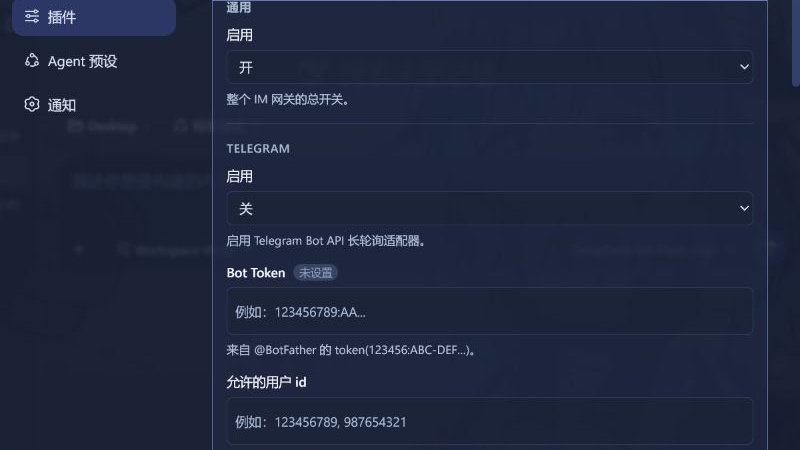
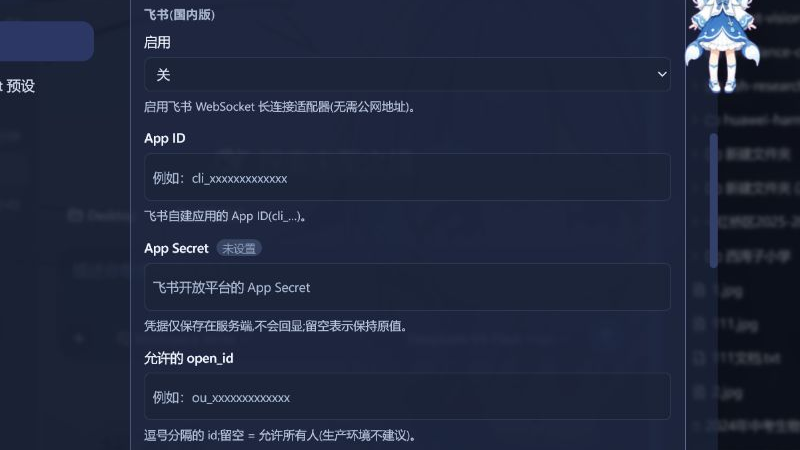
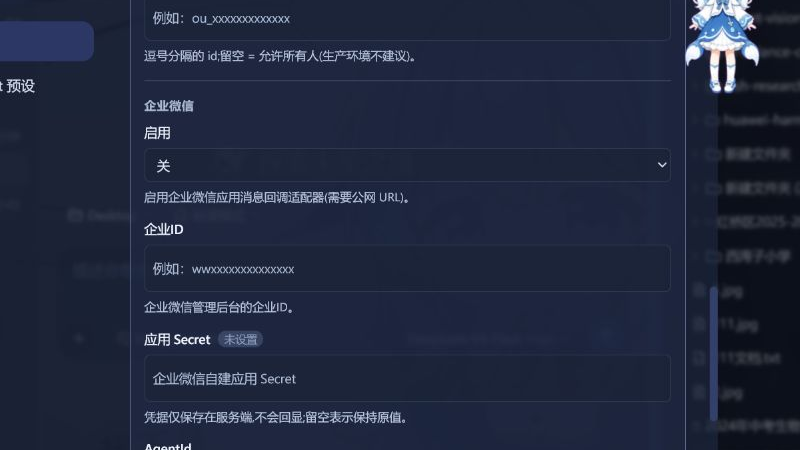
Every control states its purpose and every empty input includes a safe example. Credential values remain write-only: the screenshots below use placeholders, not real tokens or secrets.
Telegram: Bot Token and access whitelist
Feishu: App ID, App Secret, and Open ID whitelist
WeCom: enterprise ID, application credentials, and callback Token
cordis.patch.yml)The plugin row is disabled by default. Enable it from the profile's own cordis.patch.yml ($DSH_HOME/profiles/im/cordis.patch.yml):
- id: dsh-im-hub
  disabled: false
  config:
    adapters:
      telegram:
        enabled: true
        token: '123456:ABC-DEF...'
        allowedUserIds: [123456789]        # numeric Telegram user ids; empty = everyone
Full configuration reference:
| Key | Default | Description |
|---|---|---|
adapters.telegram.enabled |
false |
Enable the Telegram Bot API adapter (long polling). |
adapters.telegram.token |
'' |
Bot token from @BotFather. |
adapters.telegram.allowedUserIds |
[] |
Numeric user ids allowed to talk to the bot. |
adapters.telegram.timeoutSeconds |
50 |
getUpdates long-poll timeout. |
adapters.telegram.pollIntervalMs |
500 |
Gap after a poll timeout/error. |
adapters.feishu.enabled |
false |
Enable the Feishu adapter. |
adapters.feishu.appId / appSecret |
'' |
Feishu/Lark custom app credentials. |
adapters.feishu.mode |
'websocket' |
websocket (official long connection, no public URL) or webhook. |
adapters.feishu.webhookPath |
'/feishu' |
HTTP path for webhook mode. |
adapters.feishu.verificationToken |
'' |
Webhook event verification token. |
adapters.feishu.allowedUserIds |
[] |
Open ids allowed to talk to the bot. |
adapters.lark.enabled |
false |
Enable the international Lark adapter (same open platform as Feishu, open.larksuite.com). |
adapters.lark.appId / appSecret |
'' |
Lark custom app credentials. |
adapters.lark.mode |
'websocket' |
websocket (official long connection, no public URL) or webhook. |
adapters.lark.webhookPath |
'/lark' |
HTTP path for webhook mode. |
adapters.lark.verificationToken |
'' |
Webhook event verification token. |
adapters.lark.allowedUserIds |
[] |
Open ids allowed to talk to the bot. |
adapters.wecom.enabled |
false |
Enable the WeCom app-message callback adapter. |
adapters.wecom.corpId / corpSecret / agentId |
'' |
WeCom app credentials. |
adapters.wecom.token / encodingAesKey |
'' |
Callback Token / EncodingAESKey from the WeCom admin console. |
adapters.wecom.path |
'/wecom' |
HTTP callback path. |
adapters.wecom.allowedUserIds |
[] |
User ids allowed to talk to the bot. |
adapters.mock.enabled |
false |
Test-only adapter (stdin + local HTTP). |
adapters.mock.port |
0 |
Fixed HTTP port for the mock endpoint (0 = ephemeral). |
agent.cwd |
'' |
Working directory for agent sessions (defaults to dsh's cwd). |
agent.provider / agent.model |
'' |
Override the model selection; empty = deployment default. |
agent.maxMessageLength |
4000 |
Max chars per outbound IM message (longer replies split). |
agent.idleTimeoutMs |
1800000 |
Idle time before a chat's agent is disposed (0 = never). |
agent.instructionPrefix |
'' |
Prefix prepended to every user message. |
http.host / http.port |
0.0.0.0 / 8080 |
Bind address for webhook-mode HTTP servers (feishu webhook / wecom callback). |
im.message.receive_v1 event subscription, and grant the message permissions (im:message:send_as_bot, im:message:p2p_msg, im:message:group_msg / group_at_msg).https://your-public-host/wecom, a random Token and a 43-char EncodingAESKey, and copy them into the config.| Command | Effect |
|---|---|
/help |
Show command help. |
/reset |
Clear this chat's conversation context (fresh agent). |
/status |
Show active chats / agents / adapters. |
/model |
Show the current model selection. |
IM platform ──(adapter)──► Bridge ──► ctx.agents.create({ sessionId })
   ▲                          │                │
└──── reply text ◄─────────┴── session/event listener ◄── agent turnplatform:chatId maps to one agent session (like @deepseek-ai/dsh-headless, but kept alive per chat).source.kind = 'plugin' / form = 'relay' (community norm), and outbound text is read back from session/event (assistant/message, aggregated per turn, then chunked to maxMessageLength).agent.idleTimeoutMs and re-created on the next message.allowedUserIds on every enabled adapter before exposing the bot publicly. An empty list means anyone can drive your agent — which can execute tools on the host.token, appSecret, encodingAesKey) live in the profile's cordis.patch.yml; keep that file private.node --test test/ # unit tests (protobuf frame codec)
dsh plugin --profile im add link:D:/projects/dsh-im-hub # install from checkout
dsh --profile im --patch test/disable-skin.overlay.yml # boot with mock adapter
# POST a message: curl -X POST http://127.0.0.1:9099/mock -H 'content-type: application/json' -d '{"text":"hi","chatId":"test"}'Tip: if the dsh-skin manager (
$DSH_HOME/cordis.patch.yml) inserted a UI-skin row that your headless profile cannot resolve, disable it via a--patchoverlay (seetest/disable-skin.overlay.yml) — the home layer outranks the profile layer, so an overlay is the reliable place to turn it off.
MIT
CLASSIFICATION EVIDENCE
系统优先读取 GitHub Topics,再与站内分类词典和词根规则比对。
baka-world
DeepSeek Harness desktop notification plugin (notify-send / D-Bus)
drscrewdriver
go 语言实现的ai 基座+ tui +server系统
fieldnote-ops
Independent, default-off DingTalk Stream relay plugin for DeepSeek Harness: allowlisted sessions, ACK-first replies, and…