Agent 与会话
插件
dsh-thinking-language-zh
ayanJava111
deepseek harness思考过程中文插件
chinesedeepseek-harnessdsh-pluginprompt
PROJECT TOPICS
PROJECT README
English · 简体中文
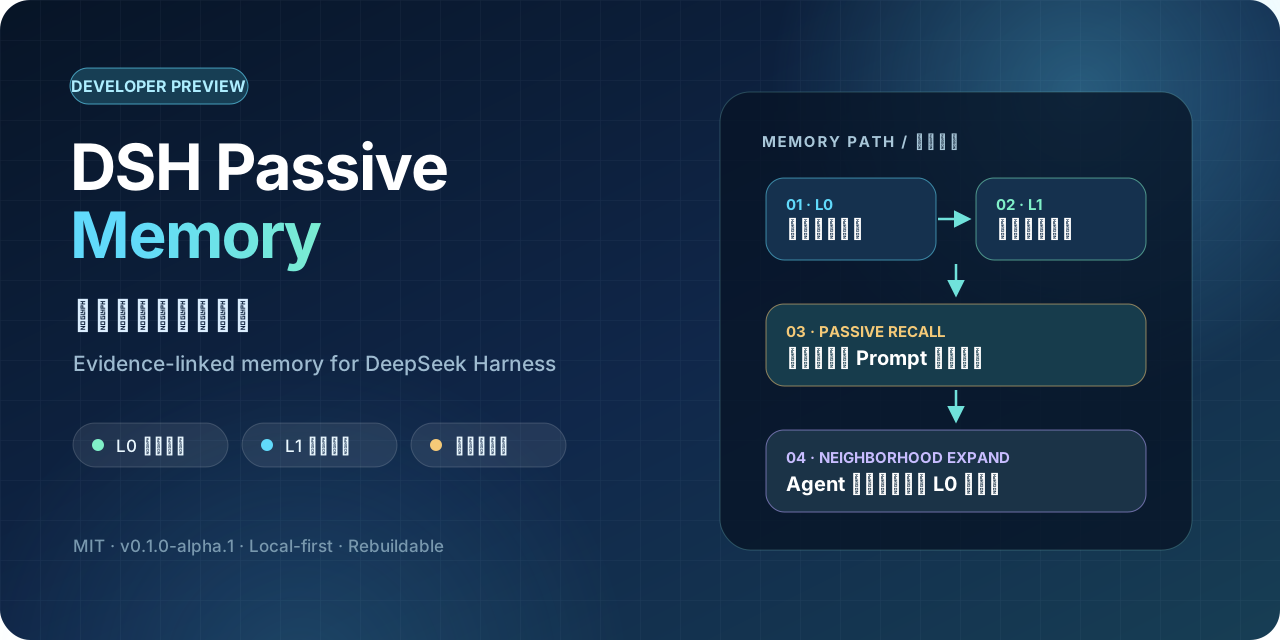
An experimental passive-memory plugin for DeepSeek Harness.
Release status:
0.1.0-alpha.1developer source preview. It is intended for one operator and a small personal archive. It is not yet an npm package or a production multi-user service.
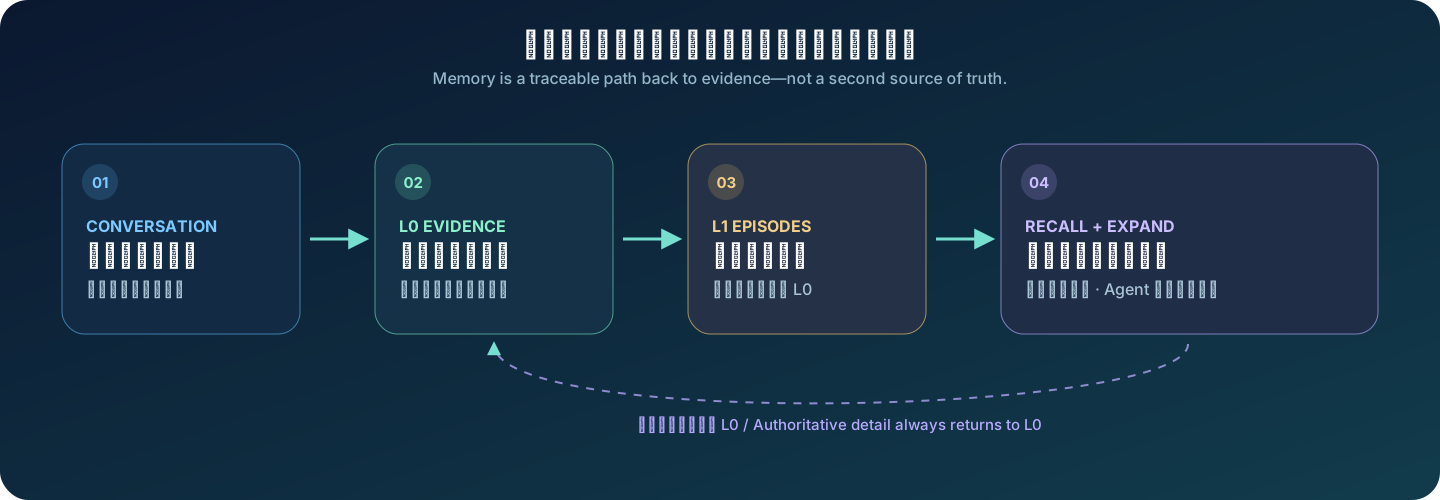
The project starts from one rule: conversation and tool events are evidence; memories are derived views. Derived memories must remain traceable to their sources and rebuildable when extraction logic changes.
The alpha release uses a sibling DeepSeek Harness source checkout. Node.js
^22.19.0 || >=24.0.0, Git, Corepack, and pnpm 11.7.0 are required.
mkdir passive-memory-workspace
cd passive-memory-workspace
git clone https://github.com/deepseek-ai/deepseek-harness.git
git clone https://github.com/MetheusNull/dsh-passive-memory.git

cd deepseek-harness
git checkout 47f943859bef60e4160492346772ded9b24f765a
corepack enable
pnpm install
pnpm run build

cd ..\dsh-passive-memory
pnpm install
Copy-Item .env.example .env
Edit .env and set one absolute database path plus three stable isolation ids:
PASSIVE_MEMORY_DB_PATH=C:/absolute/path/passive-memory.db
PASSIVE_MEMORY_USER_SCOPE=one-user
PASSIVE_MEMORY_AGENT_SCOPE=one-agent
PASSIVE_MEMORY_WORKSPACE_SCOPE=one-workspace
Build, run the complete offline test suite, and launch the local-only lexical baseline:
pnpm run build
pnpm test
pnpm run start:harness -- ../deepseek-harness lexical
Open http://127.0.0.1:3080. Lexical mode makes no external embedding request.
The episode and hybrid modes are explicitly opt-in; see
deployment/README.md. Protect the resulting database as
private conversation history and read PRIVACY.md before enabling
remote compression or embeddings.
L0 ingestion, host-side lexical/semantic retrieval, deterministic L1 candidate segmentation, opt-in automatic L1 compression, and opt-in lexical or hybrid model-visible recall are operational. L1 summaries can now enter that recall as explicitly lossy clues, while two native Harness tools let the Agent inspect their authoritative L0 sources. The repository contains:
agent/pre-step recall injection with strict scope and size bounds;memory_expand, with HMAC-authorized pagination and three bounded neighborhood rings;memory_search_raw, a scoped L0 full-text fallback for finding a new anchor;No fixture is written into a DeepSeek Harness session log. Online DSH sessions
will remain the authoritative source for native events; external history enters
through a separate source boundary and is recalled later through a DSH
form: "recall" context.
memory_expand and memory_search_raw results are derived archive projections
and are never copied back into L0.form: "recall".session/flush reports any earlier ingestion failure.A supplied real external corpus was locally verified; its displayed messages
entered L0 while its recorded reasoning traces remained quarantined and did
not enter the SQLite evidence table. The corpus and its derived metadata are
excluded from Git by LOCAL_DATA_POLICY.md.
The plugin requires a database path and explicit retrieval scopes:
plugin: "dsh-passive-memory"
config:
  path: "./runtime/passive-memory.db"
  userScope: "user"
  agentScope: "deepseek-agent"
  workspaceScope: "personal"
  journalMode: "wal"
  recallEnabled: true
  recallMaxResults: 3
  recallMaxCharacters: 2400
  recallQueryMaxTerms: 24
  semanticRecallEnabled: false
  semanticMaintenanceEnabled: true
  semanticMaintenanceIntervalMs: 60000
  semanticMaintenanceRetryBaseMs: 5000
  semanticMaintenanceRetryMaxMs: 300000
  semanticBackfillMaxRecords: 64
  semanticBatchSize: 32
  semanticCandidateDepth: 24
  semanticMinimumScore: 0.62
  fusionRankConstant: 60
  semanticFailurePolicy: lexical-fallback
  episodeCompressionEnabled: false
  episodeCompressionPromptVersion: episode-summary-v1
  episodeCompressionMaxTokens: 1024
  episodeCompressionMaxSummaryCharacters: 4000
  episodeSegmentationMaxCharacters: 12000
  episodeSegmentationIdleGapMs: 1800000
  episodeMinimumNativeTailAgeMs: 21600000
  episodeMaintenanceMaxEpisodes: 4
  episodeMaintenanceIntervalMs: 300000
  episodeMaintenanceRetryBaseMs: 30000
  episodeMaintenanceRetryMaxMs: 1800000
  episodeRecallEnabled: true
  episodeRecallMaxResults: 2
  episodeRecallMaxCharacters: 2000
  memoryToolsEnabled: true
  memoryExpandMaxDepth: 3
  memoryExpandMaxCharacters: 6000
  memoryExpandLocalRecordsEachSide: 4
  memoryExpandSessionRecordsEachSide: 16
  memoryRawSearchMaxResults: 5
  memoryRawSearchMaxCharacters: 8000
All four scope/path strings must be non-empty. The deployment, rather than the
plugin, decides what an agent and workspace identity mean. Model-visible recall
is experimental and defaults to false; the example opts in explicitly.
Semantic recall is a second opt-in and remains disabled in the example. When
enabled, its provider settings and credential come from the
PASSIVE_MEMORY_EMBEDDING_* process environment variables shown in
.env.example; the plugin configuration never contains the key.
Its document vectors are maintained in bounded background passes; the request
path sends only the current query. lexical-fallback keeps local recall
available during a provider outage, while fail-request preserves strict
failure semantics.
Episode compression is independent of model-visible recall and defaults to
false. When enabled without episodeCompressionProvider and
episodeCompressionModel, a native episode inherits the last assistant model
recorded in its L0 evidence; an episode without such provenance (including an
external import) uses Harness's current agentDefaultModel. Setting both fields
selects a fixed compression model instead. The plugin introduces no API key or
provider client of its own. Each maintenance pass can make at most
episodeMaintenanceMaxEpisodes model calls; external transcript tails are
eligible immediately, while a native session tail waits
episodeMinimumNativeTailAgeMs unless a stronger deterministic boundary closed
it. The inherited policy remains one derivation when the user later changes the
chat model, so completed memories are not recompressed; only future uncovered
episodes use the new default. Changing segmentation, closure, prompt version,
output budget, or an explicit fixed-model override creates a separate derivation.
L1 clue recall and active tools are separate opt-ins. When
episodeRecallEnabled is true, a matching title/summary is injected only as a
source-labelled clue containing an episode_id; raw text covered by that clue
is not duplicated in the automatic L0 excerpt block. memory_expand starts at
depth 1 (the exact episode mapping or evidence hit), then returns an opaque
authorization token for depth 2 (the immediate neighborhood) and depth 3 (the
broader same-collection neighborhood). The model cannot select or forge a
depth. Truncated text uses a same-depth page token, so pagination is not
mistaken for broader recall. A per-call ceiling and a per-turn ceiling of at
most memoryExpandMaxDepth × memoryExpandMaxCharacters bound tool output.
memory_search_raw remains a separate fallback rather than a fourth expansion
depth. It searches exact user/agent/workspace scopes, excludes the current
session, and returns L0 evidence IDs plus any L1 episode anchors. Both tools
label returned content as untrusted data, keep content out of their audit
records, and preserve the original content hash and source coordinates.
ctx.passiveMemory.embeddingMaintenanceStatus() exposes content-free,
process-local health counters and timestamps. See
docs/maintenance-operations-v0.1.md.
The corresponding L1 snapshot is available from
ctx.passiveMemory.episodeMaintenanceStatus().
See docs/architecture-v0.1.md and docs/import-contract-v0.1.md. Local DSH loading is documented in deployment/README.md. The privacy-preserving real-corpus check is recorded in docs/real-memory-validation-v0.1.md. The real DeepSeek Harness conversation, compression, and cross-session recall smoke is recorded in docs/live-harness-validation-2026-08-15.md. The native Agent behavior tests for one-level and recursive L0 expansion are recorded in docs/real-model-active-memory-validation-2026-08-15.md.
The model sees no additional text. The current plugin observes committed session events, writes normalized evidence, and exposes host-side lexical search.
Token effect is zero. KV-cache behavior is unchanged because no request prefix or surface message is added.
When enabled, the first step containing direct human input derives a bounded
lexical query and prepends one durable user-role context message immediately
before the direct prompt. The source is { kind: "plugin", plugin: "passive-memory", form: "recall" }. Current-session evidence, exact prompt
duplicates, duplicate excerpts, reasoning traces, and plugin-produced context
are excluded. Tool continuations do not trigger another recall.
When L1 clue recall is enabled, derived title/summary text appears in a separate
<passive_memory_clues> block. It explicitly instructs the model not to treat
the compression as factual authority and to call memory_expand before relying
on details omitted by compression. L0 remains the source of truth throughout.
The injected message has a hard character ceiling but no exact token guarantee; token cost depends on the selected model tokenizer. Because recall is a per-request suffix rather than a stable system-prompt prefix, it does not deliberately invalidate the stable-prefix KV cache. See docs/passive-recall-v0.1.md.
Every accepted recall attempt records an independent audit containing prompt and derived-query hashes, selected evidence/source ids, BM25 scores, limits, outcome, and rendered-text hash. Prompt and recalled text are not duplicated in the audit row.
AI.semanticFailurePolicy. Local store and consistency
errors always fail explicitly.Legacy files may contain text labelled as model reasoning. Such blocks are kept
for source fidelity but are marked restricted, quarantined, and ineligible
for default memory indexing or replay. Final answers and user messages remain
eligible L0 evidence.
Run the public lexical recall baseline with npm run evaluate:recall. It uses
only synthetic fixtures and reports outcomes and counts without printing prompt
or memory content.
The optional embedding-provider boundary and one-request connectivity probe are documented in docs/embedding-provider-v0.1.md. Live semantic recall remains separately opt-in and requires explicit provider configuration and credentials.
The most useful report is a reproducible memory behavior: a missed recall, a false recall, an L1 clue whose expansion did not reach the necessary L0, a scope leak, or a memory feedback loop. The repository provides dedicated issue forms for memory quality, bugs, and feature requests.
Use synthetic or redacted examples. Never post credentials, complete private transcripts, databases, or private filesystem paths. See CONTRIBUTING.md for the reporting contract.
This project is released under the MIT License. It is an
independent implementation inspired in part by the passive-memory-emergence
ideas explored by lionsky through VCPToolBox and RiverMemo / 浪潮 Memo. No VCP
source code or VCP-specific algorithm implementation is included in release
0.1.0-alpha.1.
See NOTICE.md, VCP_PROVENANCE.md, and DSH_PROVENANCE.md for attribution and provenance. Runtime data handling and security boundaries are documented in PRIVACY.md and SECURITY.md.
Release history is recorded in CHANGELOG.md. The alpha publication checks are recorded in docs/release-verification-v0.1.md.
CLASSIFICATION EVIDENCE
系统优先读取 GitHub Topics,再与站内分类词典和词根规则比对。
ayanJava111
deepseek harness思考过程中文插件
ben7am1n
Durable cross-session SQLite memory for DeepSeek Harness
chenkezhen480
为deepseek-harness添加向量化跨会话记忆插件