文件与数据
插件
dsh-plugin-verified-search
f0909172434
Verified current-source search workflow for DeepSeek Harness
deepseekdeepseek-harnessdshdsh-plugin
PROJECT TOPICS
PROJECT README




Generate images in DeepSeek Harness with OpenAI gpt-image-2, using a signed-in Codex subscription by default or an API key when explicitly configured.
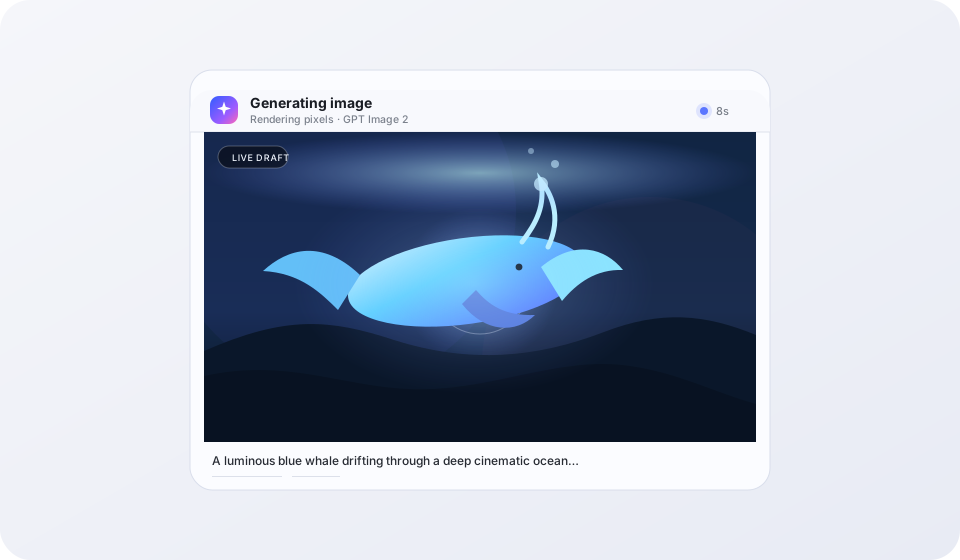
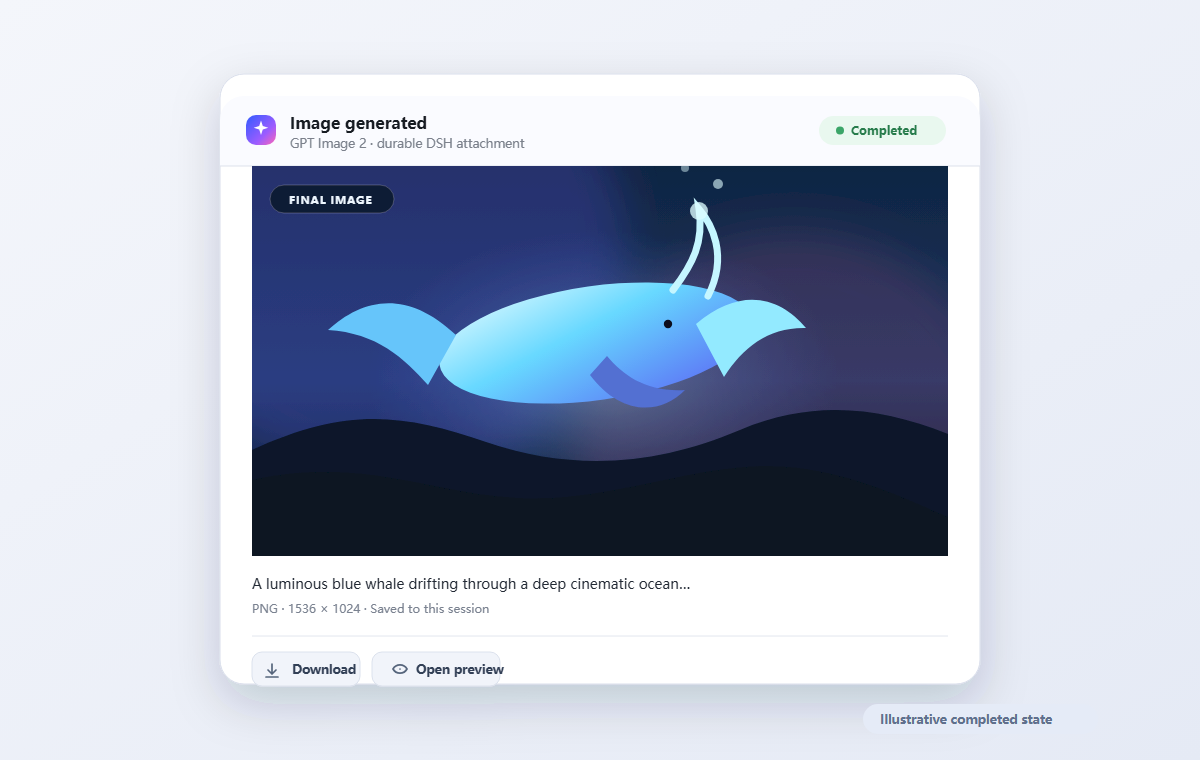
These illustrations mirror the shipped developing and completed card states. API-key mode can replace the light field with real streamed drafts; Codex subscription mode animates until its non-streaming response arrives. The completed state remains available as a durable DSH attachment with preview and download controls.
| Area | Delivered behavior |
|---|---|
| Tool and access paths | Exposes the Codex-compatible image_gen tool for gpt-image-2; defaults to refreshable dsh-codex-connect subscription OAuth and can explicitly use a DSH API-key credential. |
| Progressive experience | Subscription requests show a developing animation until their non-streaming result; API-key requests can show up to three provider-sent partial images, cross-faded in place. |
| Durable results | Saves only the completed image as a DSH immutable attachment, so the same card can replay, preview in a lightbox, and download after a session reload. |
| Conversation compatibility | Returns text-only tool output to the model while retaining the image reference in UI metadata, including for nested Code Mode calls. |
| Safety boundaries | Resolves credentials per request, pins the subscription endpoint, rejects redirects, bounds response sizes and concurrency, validates image bytes through DSH, and retries only transient failures. |
image_gen.dsh-codex-connect; no OPENAI_API_KEY is required for Codex subscription mode.prefers-reduced-motion support.OpenAI Codex's built-in image_gen tool hardcodes gpt-image-2, calls the ChatGPT Codex Images endpoint with subscription OAuth, records one working state, and saves the completed image under Codex's generated-images directory. Its public backend currently requests a non-streaming JSON response and its UI does not expose a distinctive diffusion animation.
dsh-image-gen keeps the compatible image_gen name and model while improving the visible process:
| Experience | Codex | dsh-image-gen |
|---|---|---|
| GPT Image 2 | Yes | Yes |
| Progressive provider frames | Subscription path is currently non-streaming | Subscription animation; API-key mode supports up to 3 live frames |
| Before first frame | Generic working state | Animated developing plate, scan, and light field |
| Frame transition | Generic activity | In-place cross-fade and focus development |
| Final result | Saved image | Durable DSH attachment, replay, lightbox, download |
| Text-only model compatibility | Not applicable to DSH history | Model receives text; image reference stays in UI metadata |
| Reduced motion | Platform dependent | Explicitly supported |
Primary references:
Verified against:
0.1.0-rc.6dsh-codex-connect 0.1.0-alpha.4.424.15.0 (package support: ^22.19.0 or >=24.0.0)Verification date: 2026-08-15.
Review third-party source before installation and pin release tags or commits. For the default keyless subscription path, install Codex Connect, sign in once, then install this plugin:
dsh plugin --profile web add dsh-codex-connect
dsh openai-codex login
dsh plugin --profile web add github:LeemanCheung/dsh-image-gen#v0.2.0
For local development:
git clone https://github.com/LeemanCheung/dsh-image-gen.git
cd dsh-image-gen
npm install
npm run check
dsh plugin --profile web add .
The repository commits lib/index.js and lib/client.js, so a pinned Git install does not need to run a dependency build script. Restart the DSH Host after installation and refresh the Web page.
authMode: auto is the default. It first asks the installed dsh-codex-connect package for its DSH-owned, refreshable ChatGPT OAuth credential and sends it only to the fixed first-party endpoint https://chatgpt.com/backend-api/codex/images/generations. If Codex credential resolution, compatibility checking, or refresh fails for any non-cancelled reason, it then tries the DSH credential reference named by apiKeyEnv (default OPENAI_API_KEY); if neither works, it returns the combined failure. codex-subscription never falls back.
Use authMode: codex-subscription to forbid API-key fallback, or authMode: api-key to use only the configured Images API account. Never put an OAuth token or API key in cordis.patch.yml, chat messages, Git, or screenshots. The plugin resolves authentication for every generation and does not retain it after the request.
Ask naturally in a DSH conversation, for example:
Generate a cinematic 16:9 product photograph of a translucent mechanical keyboard on a dark glass desk, violet rim light, no text.
The model calls image_gen. While it runs, the card shows the developing animation. API-key mode replaces the light field with each real streamed partial; Codex subscription mode reveals the final image when its JSON response arrives. DSH's existing interrupt control cancels the request. The settled card supports preview and download.
Tool options:
prompt: detailed generation instructions, 1–32,000 characters and at most 64,000 UTF-8 bytes.size: auto or arbitrary WIDTHxHEIGHT accepted by GPT Image 2: each edge divisible by 16, no edge above 3840, aspect ratio 1:3–3:1, and 655,360–8,294,400 total pixels.quality: auto, low, medium, or high.output_format: png, jpeg, or webp in API-key mode. Codex subscription mode currently returns PNG.output_compression: 0–100 for API-key JPEG/WebP only.background: auto or opaque. GPT Image 2 does not support transparent output.The bundle inserts the image-gen row with safe defaults. Override it in the selected profile's cordis.patch.yml:
- id: image-gen
  name: dsh-image-gen
  config:
    authMode: auto # auto | codex-subscription | api-key
    apiKeyEnv: OPENAI_API_KEY
    baseUrl: https://api.openai.com/v1
    model: gpt-image-2
    defaultSize: auto
    defaultQuality: auto
    defaultOutputFormat: png
    defaultOutputCompression: 90
    defaultBackground: auto
    moderation: auto
    partialImages: 3
    requestTimeoutMs: 120000
    maxRetries: 2
    retryBaseMs: 1000
maxConcurrent: 2baseUrl, model, moderation, partialImages, output compression, and API pricing apply only to API-key mode. Codex subscription mode fixes the model to gpt-image-2, uses the fixed first-party Codex endpoint, returns PNG, and never sends OAuth to baseUrl. Configuration fails at load for an invalid provider URL or default image size. Plain HTTP is accepted only for loopback development endpoints. Every credential-bearing request uses redirect: "error".
Create a DSH credential named by apiKeyEnv (default OPENAI_API_KEY) or export that environment variable before starting the DSH Host, then set authMode: api-key. Never put the secret in the profile patch.
A custom baseUrl must expose <baseUrl>/images/generations and support either an OpenAI-compatible data[0].b64_json response or SSE image_generation.partial_image / image_generation.completed events carrying b64_json. It must be HTTPS outside loopback.
| Setting | Accepted range / behavior |
|---|---|
partialImages |
0–3; API-key mode only. |
requestTimeoutMs |
10,000–300,000 ms for the whole operation. |
maxRetries |
0–5; total attempts are maxRetries + 1. |
retryBaseMs |
100–30,000 ms before bounded exponential backoff. |
maxConcurrent |
1–8; an operation at the limit is rejected immediately rather than queued. |
Only transient provider failures (429, 5xx, retryable protocol/response errors, and network failures) are retried. Provider moderation and user-input errors fail immediately.
Codex subscription calls consume the image-generation allowance associated with the signed-in ChatGPT plan. API-key calls are billed by the selected quality and size; each requested partial costs additional image-output tokens according to the provider guide. partialImages does not apply to subscription mode.
https://chatgpt.com/backend-api/codex/images/generations; API-key mode sends them to baseUrl.dsh-codex-connect for its DSH-owned OAuth credential; API-key mode resolves the configured DSH credential reference. Neither secret is stored in plugin state, logs, metadata, or session history.OpenAI Codex is signed outInstall dsh-codex-connect, sign in from its DSH settings page or run dsh openai-codex login, then retry. Never paste the OAuth token into chat.
No credential is configured for OPENAI_API_KEYThis appears in explicit API-key mode, or after automatic Codex fallback. Configure the credential for the DSH Host process or switch to a signed-in Codex subscription. Never send the key in chat.
Revise the prompt. The plugin does not retry provider moderation or user-input errors.
Refresh the page. If the card still cannot load, inspect Host logs and verify that the profile still mounts dsh-image-gen and its attachment store is available.
dsh plugin --profile web why dsh-image-gen
dsh --profile web --dump-configIncrease requestTimeoutMs within its 10–300 second range or select a lower quality. API-key mode can also use JPEG. DSH interruption still aborts the upstream request.
Before changing a production profile, take a DSH config snapshot when the undo plugin is installed. To uninstall:
dsh plugin --profile web remove dsh-image-genRestart the DSH Host and refresh the page. Existing image records remain in session history; their custom card requires the plugin to be installed.
npm install
npm run typecheck
npm test
npm run build
npm pack --dry-run
The keyless suite uses deterministic mocked SSE/JSON responses and a local redirect server. It covers both authentication modes without reading real secrets. Real-provider checks are manual because they consume a Codex subscription allowance or bill an API account. The 0.2.0 release was manually verified with one signed-in Codex subscription generation and cold-session browser replay.
The build emits:
lib/index.js: Host Cordis plugin.lib/client.js: browser module-loader bundle.lib/client.js.map: browser source map.See SECURITY.md for private reporting. Do not include OAuth tokens, API keys, private prompts, or generated private images in a public issue.
CLASSIFICATION EVIDENCE
系统优先读取 GitHub Topics,再与站内分类词典和词根规则比对。
f0909172434
Verified current-source search workflow for DeepSeek Harness
fryghost
Community plugin for DeepSeek Harness: give text-only models eyes - paste images natively, described via an OpenAI-compa…
gloryxpnv
Local-first vision for DeepSeek Harness: structured JSON evidence (OCR/layout/semantics) from local VLMs (LM Studio/Olla…