
生活娱乐
插件
dsh-web-speech-input
leozou320-ai
Voice-to-text for the DeepSeek Harness Web UI — live, editable, never auto-sends. | DeepSeek Harness 网页语音输入
accessibilitydeepseekdeepseek-harnessdsh-plugin
KCNyu/clawock
AI argues. Code settles. The losses stay on the page. A real HK + US brokerage account run by agents that must debate every call, settled by code the model never touches. Install the same decision workflow into your own agent: OpenClaw, Claude Code, Codex, or DeepSeek Harness.
PROJECT TOPICS
PROJECT README

A real Hong Kong + US brokerage account, run day after day by agents that debate every call before it happens, then settled by code the model never touches. Every result gets published, wins and losses both. Install the same decision workflow into your own agent, in any harness: OpenClaw, Claude Code, Codex, DeepSeek Harness, or one you write yourself.





Live dashboard · Daily briefs · Evidence · 简体中文
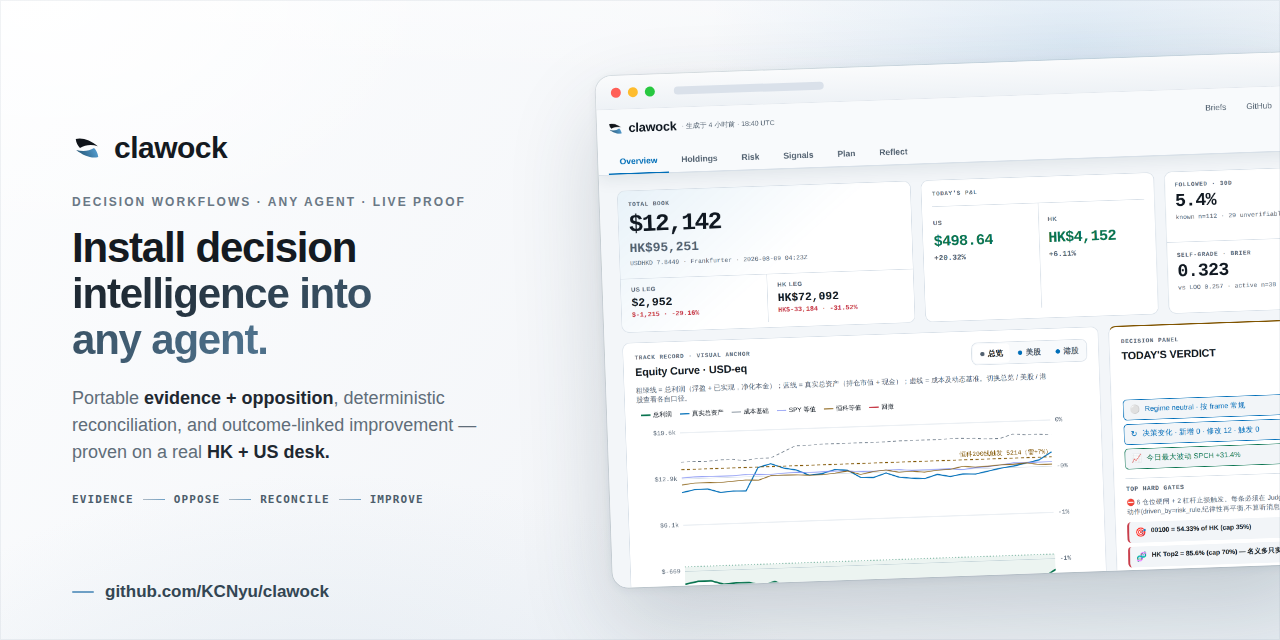
“The market doesn't care how confident the model was.”
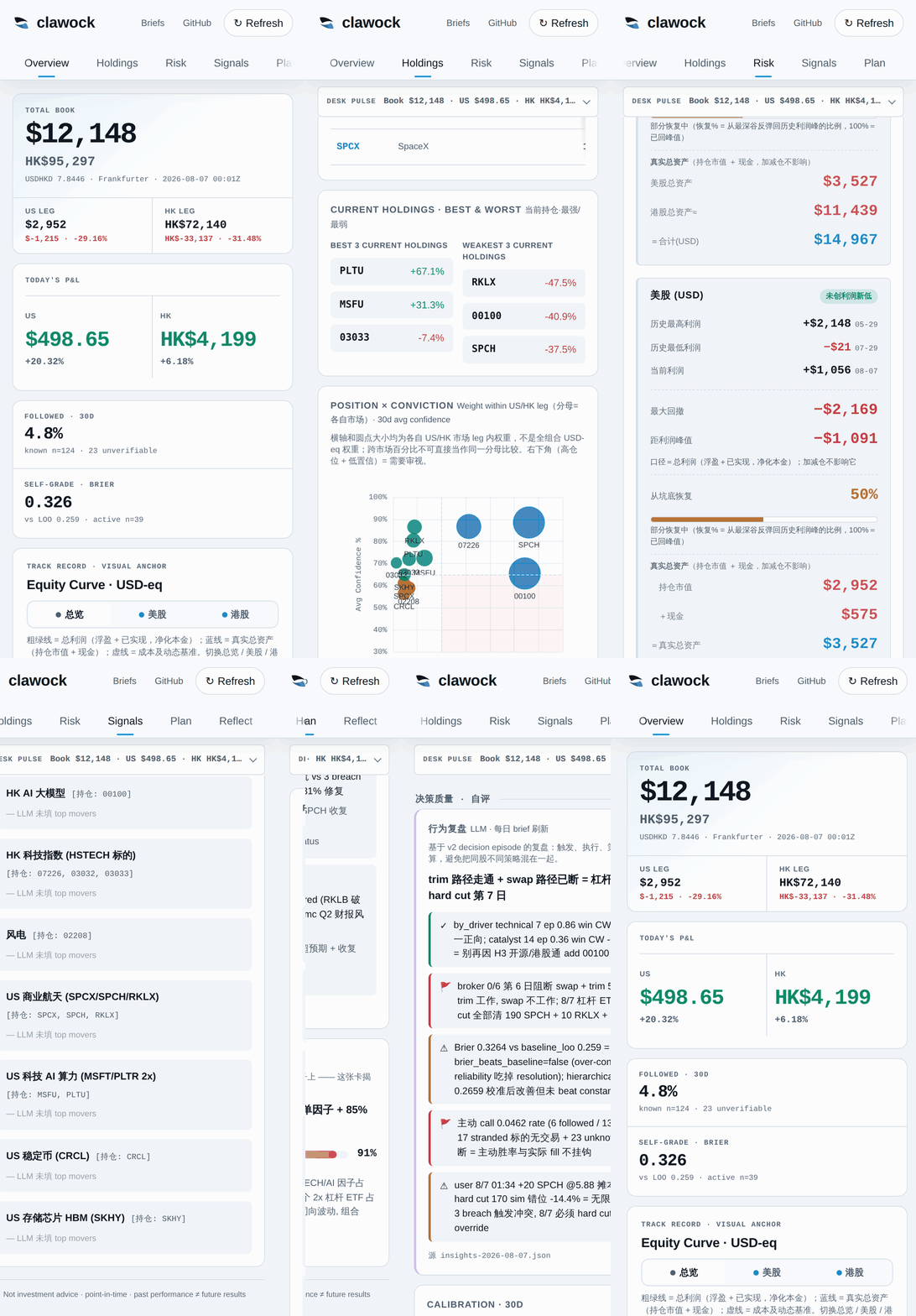
Real positions, real P&L, graded in the open. Previews refresh weekly; the live dashboard updates through the trading day.
This started as one account, not a package. A multi-agent desk debates the evidence on a real brokerage account with separate Hong Kong and US books and proposes trades; the account owner still places the orders. What comes out of that is the record: real positions, a growing decision history, and a public scorecard the model has no say in — not a get-rich bot, and not a copy-trading service.
clawock is the part of that desk we pulled out and made reusable: an
agent-native, harness-agnostic investment decision-workflow plugin with a
verifiable harness. OpenClaw, Claude Code, Codex, DeepSeek Harness, or
another external runtime keeps the model call, the conversation, memory,
planning, tools, permissions and credentials. clawock installs the workflow on
top of that: it certifies evidence, forces an opposing case, checks the money
and FX arithmetic, links outcomes back to the decision that caused them, and
keeps every improvement proposal reviewable and reversible. Swap harnesses and
the decision contract stays put — it's just files and a CLI. See
examples/ for the
same run done from a pure CLI, an OpenClaw skill, a Claude Code instruction, a Codex AGENTS.md,
and a DeepSeek Harness agent.
Install it with pip install clawock, or
run it on your own book without this repository at
all. The model proposes; Python owns the prices, the risk limits, the ledger,
the settlement, and the grading.
The product boundary is simple: the external agent reads and reasons; clawock owns the portable decision workflow and the deterministic truth around it.
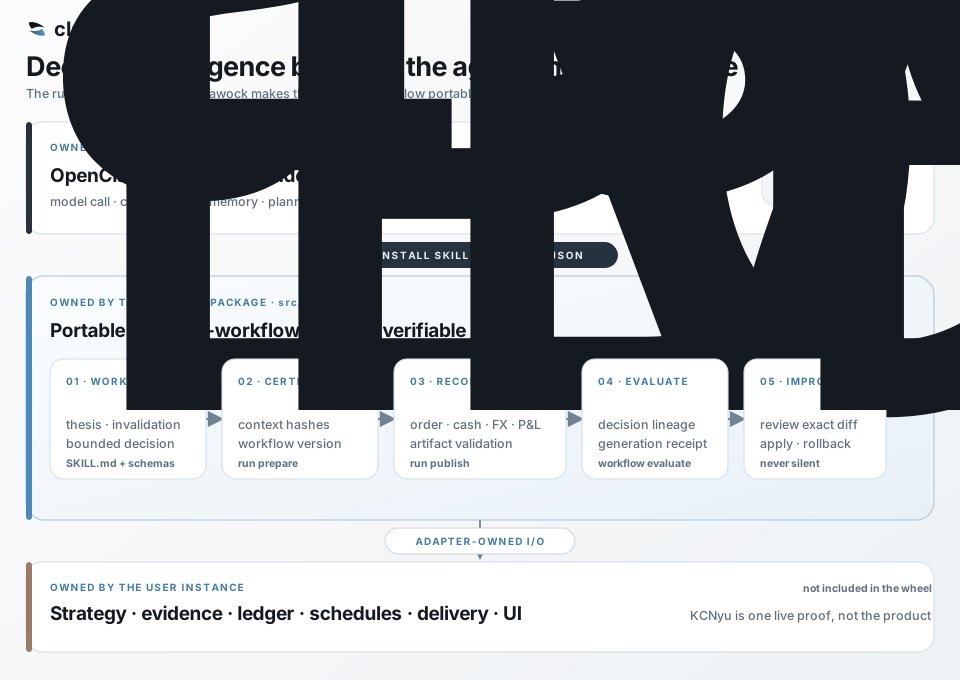
The KCNyu deployment then applies that product boundary to one live portfolio. This second diagram is the deployed KCNyu desk, not the reusable package boundary.
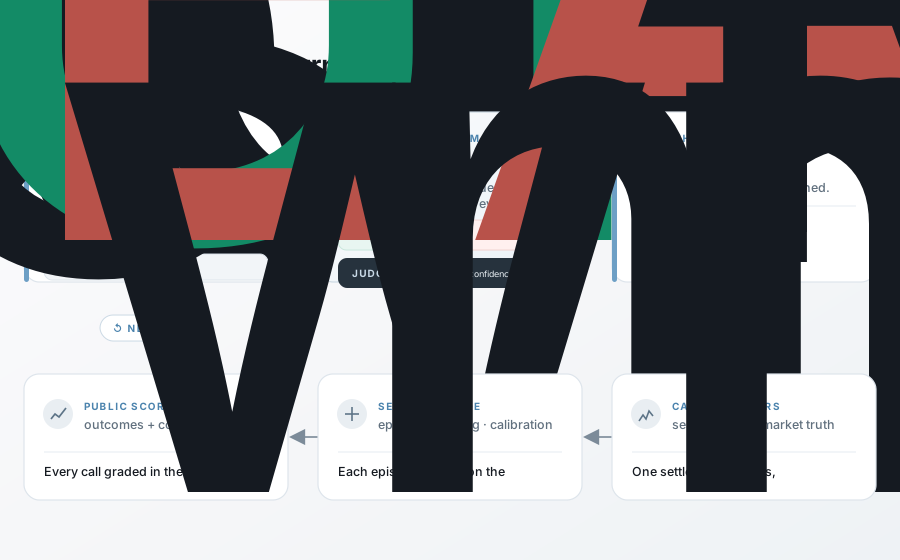
Every trading day the system pulls fresh prices, FX, volatility, earnings and macro context plus news and social sentiment; hands that normalized context to a multi-agent debate; applies deterministic risk, schema, and ledger gates in Python; delivers a brief to WeChat; and updates the public dashboard.
Reading the market is most of what the LLM does, so the widest part of the system is data collection. The repository catalogs 41 fetch and compute modules across 8 layers, with bilingual Hong Kong + US coverage — live quotes, SEC + Eastmoney filings, capital flow, earnings calendars, macro (VIX / DXY / 10Y), Reddit and news sentiment, and market-moving social feeds. Each brief consumes the subset relevant to that market and session. Collection stays broad; the decision layer stays constrained.

| Layer | Modules | Primary sources |
|---|---|---|
| 1 · Market | 7 | Tencent · Yahoo · Eastmoney · Polygon |
| 2 · Fundamentals & filings | 3 | SEC EDGAR · Eastmoney datacenter · HKEX |
| 3 · Capital flow | 1 | Eastmoney push2his |
| 4 · News & catalysts (bilingual) | 5 | Eastmoney · Finnhub · Google News · exchange filings |
| 5 · Macro & sentiment | 3 | Yahoo · Reddit · CNN · social feeds |
| 6 · Quant & risk | 9 | deterministic math over price history |
| 7 · Book & FX integrity | 6 | Frankfurter · the reconciliation ledger · local invariants |
| 8 · Backtest & calibration | 7 | local snapshots + canonical bars |
The fetch layer degrades gracefully: every live Eastmoney call routes through one throttled gateway, critical paths (quotes, FX) use multi-source fallback, and an empty fetch keeps the prior value instead of overwriting a good series with a blank. Public sources include Tencent, stooq, yfinance, Frankfurter, SEC EDGAR, Finnhub, Nasdaq, Eastmoney, Polygon, Alpha Vantage, Reddit, and Google News — full command and provider catalog in the command reference, whose inventory is generated from the same registries this table is checked against. Which module sits in which layer is itself an artifact — config/information-layers.json, where every packaged command is either in a layer or listed with the reason it is not collection — and CI checks the table above against it, so a module that moves cannot leave its count standing.
Collection is broad, but no run gets everything. Each scheduled job's preflight assembles only the blocks that job can act on, writes them to a context file, and the model reads that file rather than fetching for itself.
sources
  ──► preflight (Python, deterministic)
  ──► context.json
  ──► LLM prose
  ──► postflight (Python)
  ──► publish
Pre-open gets the most: full position truth, risk, signals, the evidence graph, research state, and it writes the day's plan. The open/midday/close runs travel light — a fresh quote, risk only when signals demand it. Intraday check-ins (every 30 minutes a market is open) sit in between: more signal detail, but no research production and no evidence-graph rebuild, because that is a daily artifact and would be stale by construction.
| Pre-open brief | Open / midday / afternoon / close | Intraday check-in | |
|---|---|---|---|
| When | 08:00 HKT, weekdays | HK 09:30 · 12:00 · 13:30 · 16:00 · US open and close | every 30 min while a market is open |
| Blocks | 39 | 16 | 28 |
| Position truth | holdings, book totals, concentration, leverage look-through | fresh quote block | fresh quote block |
| Risk | guardrail, discipline ledger, β/vol/drawdown, breakeven math | risk section only when signals demand it | signal counts and detail |
| Signals | quant factors and their hit-rate review, cross-sectional factor, peer residual, T+0 setups | peer/sector scan | peer/sector scan, T+0 setups, anomaly flags, entry setups and early-trend candidates re-run on the open bar, price-surface opportunity radar |
| News and events | evidence graph, Chinese-language company news, catalyst calendar, macro, Reddit and social feeds | catalyst probe on flagged names | catalyst probe on flagged names |
| Research state | thesis registry, research work queue (reviews due, overdue promises, ungated positions) | thesis and red lines for flagged names | thesis and red lines for flagged names |
| History | retrospective, decision metrics, reflections, data-integrity report | — | heartbeat slot state |
| Today's plan | writes it | the morning's still-open decisions for this leg | the morning's still-open decisions for this leg |
The catalyst probe is the narrow, time-sensitive one: it fires only for names that already moved, reads exchange and regulator filings first (SEC acceptance timestamps, HKEX announcements), classifies each item as interrupt, context or noise, and states no_recent_filing explicitly rather than letting an empty block read as "nothing happened".
The system scans Trump (Truth Social, first-party) and Musk (news aggregation) one to two times a day on the HK/US session clock, then an LLM filters the noise and links what's left to actual holdings and sectors: stance (endorse / oppose), relevance, and a plain-language summary. Who said what, and whether it touches your book, is already sitting in the pre-open brief — nobody has to go scroll social media for it.
A concrete example: on 2026-08-13 Trump announced a de minimis tariff-loophole ruling; the radar matched it to retail/e-commerce and linked it to the Hang Seng Tech position, and the summary landed in the next day's brief. The scan the day before (2026-08-14) found 3 posts and zero holding hits — an empty result is published as an empty result, not skipped. What's shown above is one hit; misses go in the brief exactly as often as they happen.
Analysis resolves into explicit, gated strategy decisions — and one stock can carry several at once.
core_position, risk_rebalance, intraday_t, event_trade, and tactical_entry can coexist on the same name, because a long-term thesis and an intraday trade can legitimately disagree. Each is graded in its own episode.Adding to a position needs two independent signals to agree: a price/peer signal (factor rank plus curated-peer residual) and a separate, point-in-time news signal (reliable positive surprise or accelerating attention) — not one moving average mistaken for alpha. Negative information or peer-laggard evidence blocks it outright, sizing stays capped and tranche-based (a warming policy earns a small exploration slice, not validated authority), and a small rank wobble can't churn permission off and on.
The daily deep brief runs a structured multi-agent debate, adapted from TradingAgents for separate Hong Kong and US books. More agents isn't the point: the protocol demands an opposing case, and the Judge attributes each resolution to a named strategy frame.
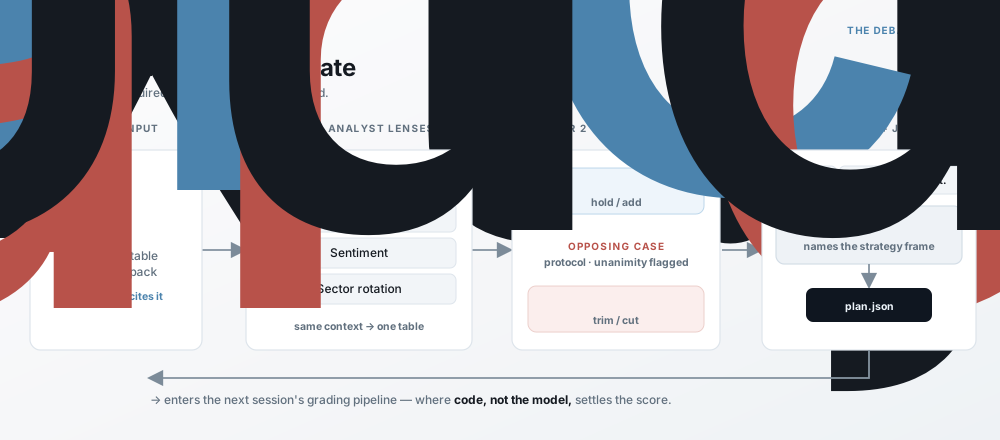
plan.json — which enters the next session's grading pipeline.Every call is settled mechanically and published — wins, losses, and the cases that can't be graded. Nothing is hand-tuned after the fact.
memory/decisions.jsonl.The model submits decisions; it can never write or amend its own evaluation. That isolation stops the desk from grading itself — it does not make the market data or the metric definitions correct. Treat the record as a diagnostic, not as proof of return.
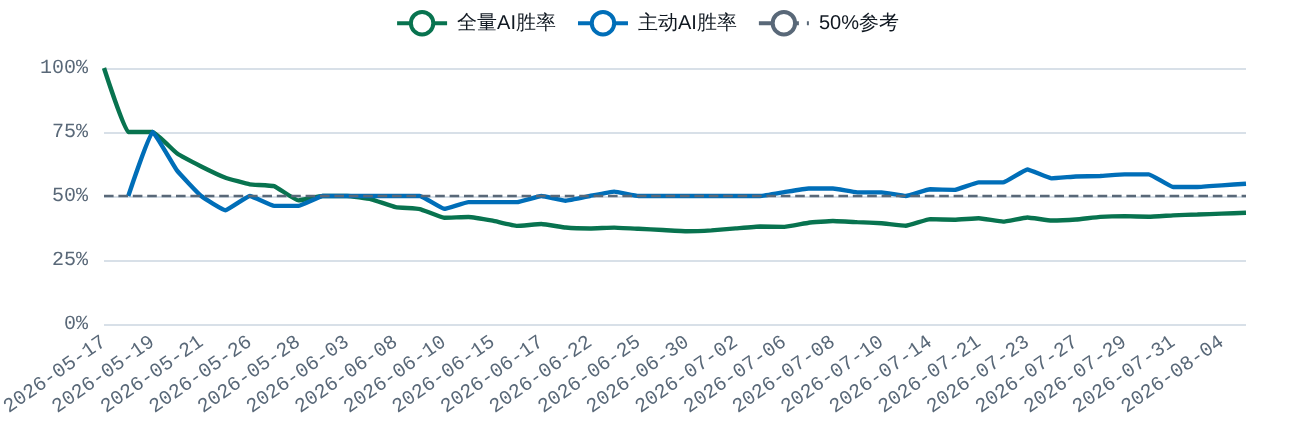
Cumulative episode win rate against a 50% directional-hit line — how often the direction was right, not what it earned. The buy-and-hold comparison is the Shadow Portfolio under Holdings; this is a different question. Refreshed weekly by GitHub Actions; live figures are on the Holdings tab.
memory/bars/ — unadjusted daily bars from a single canonical vendor feed, not an exchange feed. An unfinished session never grades anything.assets/data/shadow_portfolio.json. It is a policy simulation, not a claim about what the live account earned.The scorecard reports what happened. This reports what was checked — and what did not survive the check.
A layer has to clear a stated bar before it is allowed to influence a decision, and the bar is set before the result is known:
Results are published whether or not they flatter the system. The dial's permutation test is the current example: on the sample available, its timing cannot be distinguished from chance, and that is stated on the page rather than left out of it. A failure to reject is not a refutation, and the page says which one it is.
Two properties keep this from decaying into copy. The page is generated from the artifacts, so it cannot quietly drift from them. And any backtest figure quoted in the repository has to cite a run card that still contains it — a stale citation points at real evidence that no longer says what the claim says, which reads as credible and is wrong. CI fails on both.
The model writes opinions. The arithmetic that could corrupt the record runs in Python and is unit-tested.
That path is covered by a large unit-test suite — it's what keeps the system stable. Currencies never sum (HKD and USD are shown separately, rate and timestamp stamped), risk caps are checked every brief (single name ≤35%, Top-2 ≤70%, portfolio β ≤3.0, stop at −18%), and a thesis moves only on new evidence, never on a price move alone.
| Rule | What the code does |
|---|---|
| Currencies never sum | HKD and USD are shown in both views with the rate + timestamp stamped; adding them naively is a meaningless number. |
| Risk caps, checked every brief | Single name ≤35%, Top-2 ≤70%, leverage-ETF sleeve ≤50%, portfolio β ≤3.0, stop at −18%. Each breach has a durable age, acknowledgement, expiring override and execution-evidence record; same-risk adds freeze until compliance. Execution stays human. |
| Concentration per leg | HHI = Σ wᵢ² per book: <0.15 ✅ · 0.15–0.25 🟡 · 0.25–0.40 🟠 · >0.40 🔴. Never blended across currencies. |
| Leverage judged by regime | A 200-day-trend × volatility dial caps the leverage-ETF sleeve (×1 / ×0.5 / ×0); daily-reset 2×/3× products skip fundamentals entirely. |
| Return on peak principal | Return % uses peak net deposits from the cash-flow ledger, not cost − realized — a realized win must not fake a higher return. |
| News needs an evidence graph | Filings, issuer/exchange news, calendars, and headlines are deduplicated into expiring event IDs. A reliable, novel, negative event with price/volume or validated peer confirmation may drive defensive action. Positive surprise or accelerating attention can only join price-relative evidence in a capped add exploration; it cannot trade alone. |
| Unproven signals get an exploration boundary | A quant factor cannot claim validated authority until it clears prospective activation. While warming up, a pre-registered interaction can collect one capped tranche per ticker/policy; the ledger keeps that evidence grade distinct. |
| Add authority needs quant × information | Factor and peer residual count as one price-relative family, not two votes. A second point-in-time news surprise/attention family must agree before an exploration or validated tranche exists; technical prices only time that already-authorized capital. |
| Published research numbers need two sources | Long-form numbers carry a provenance manifest: exact Decimal arithmetic, two independent sources per figure, and a tolerance cap the manifest cannot raise for itself. A single-sourced or disagreeing figure blocks release of the artifact that quotes it. |
| A thesis moves only on new evidence | Assumptions, red lines and valuation anchors live in versioned JSON. A dimension may change only with evidence observed after the last check; a price move can reprice valuation but cannot touch business, moat or management; triggering and clearing a red line both need evidence. A missing baseline stays unknown instead of being reconstructed from prose. |
| Earnings quality is computed, not asserted | Cash conversion, working-capital gaps, dilution, SBC share and guidance outcomes are derived in code from at least four comparable periods. A basis or currency switch mid-history is an error, a missing input reads unavailable with a reason, and footnote claims require a primary issuer document. |
| A new name passes a gate before a research run | Information richness is graded separately from investment quality, so thin sourcing returns gray_needs_evidence, never a rejection. Four hard vetoes resolve before any check is tallied, their industry exceptions are encoded per sector rather than improvised, and quotes must come from the workspace pipelines. |
Reliability rides on the same principle. Every market-reporting job is preflight (Python) → LLM → postflight (Python): the deterministic work runs in code, and a pre-push gate refuses to publish a book that doesn't reconcile. If risk can't be computed, the card says "risk unavailable," never a green "none." Overlapping schedulers, a fallback workflow, and watchdogs mean a single LLM stall is no longer silent — though nothing here promises delivery under every outage.
overnight  memory "dreaming" — promote yesterday's lessons into long-term notes
morning    deep brief — multi-tier debate + a judge, ships to WeChat
HK session open → scheduled intraday monitors → close
US session open → split intraday monitors → close
             ↑ every successful reporting run publishes dashboard changes
around it  pre-brief macro / sentiment / event scans, then a pre-US-open news digest
weekly     archive, health, review, and visual-refresh jobs
Hong Kong times run on HKT; US session times follow ET and their cron expressions shift automatically with New York DST. A holiday + weekend gate skips closed sessions. The exact generated table is in docs/operations/cron-schedules.md.
The package lifecycle is no longer welded to this account's directory. It is published to PyPI through GitHub trusted publishing — no API token, and the release job proves a clean environment can install the exact artifact and finish a run before it uploads:
python -m pip install clawock
clawock workflow install investment-decision --workspace ./my-decision
clawock init ./my-decision --workflow investment-decision
clawock run prepare --workspace ./my-decision
You need Python ≥ 3.11 and an agent that can read a file and write
decision.json — any harness works, and the model call stays entirely in your
runtime. The emitted request is for the external agent to consume. The agent
writes decision.json; clawock run publish validates it and emits the
correlated generation receipt. The packaged example can smoke the lifecycle
without a model (bash examples/cli/minimal-run/run.sh), and
examples/ shows the
same run driven from a pure CLI, an OpenClaw skill, a Claude Code instruction, a Codex AGENTS.md,
and a DeepSeek Harness agent — the harness never touches the contract.
Two harnesses, two completely different interfaces, one decision.json on
each side. Claude Code stays a terminal loop — prepare, read, write, publish:
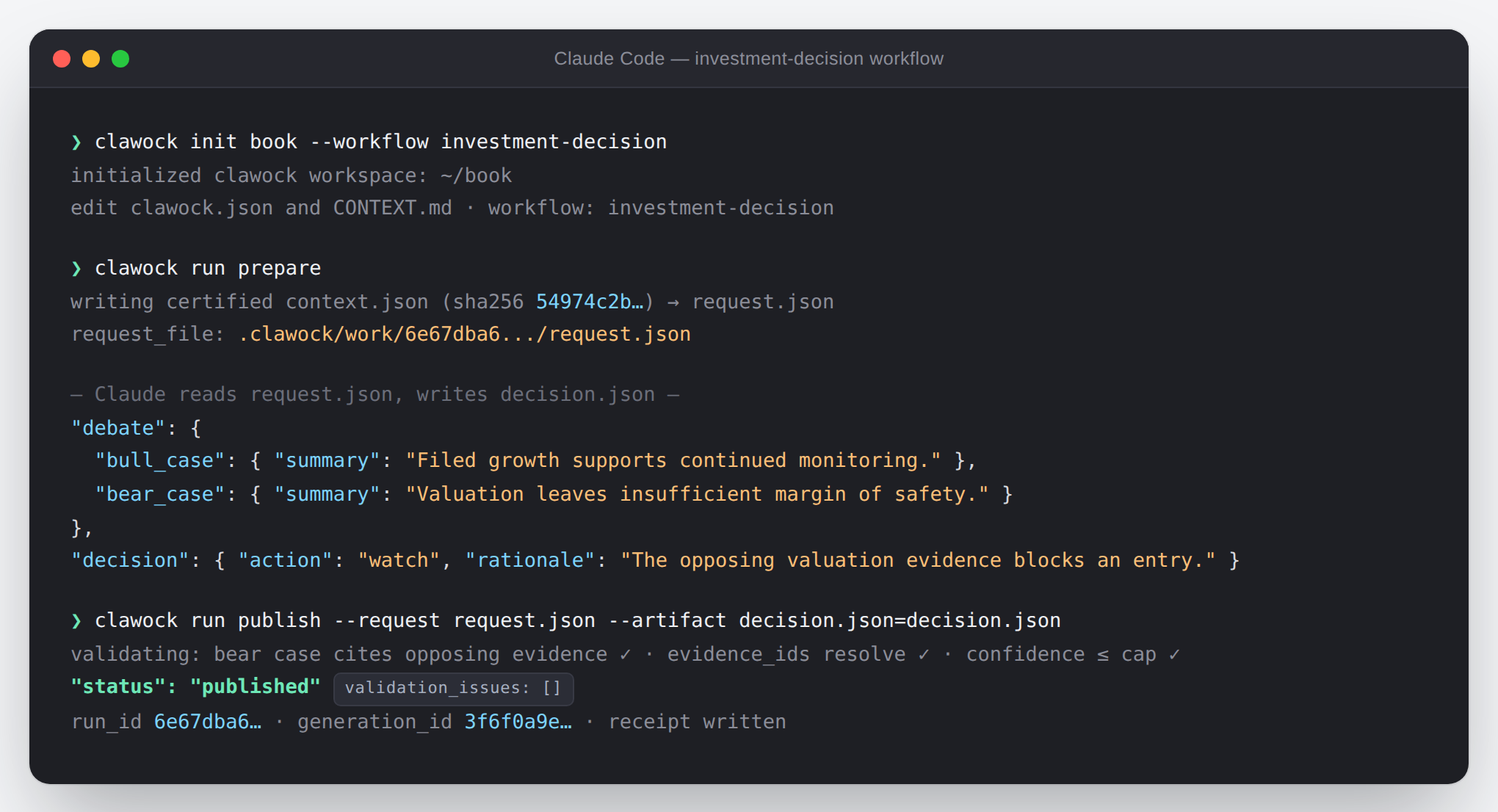
DeepSeek Harness gets a native panel instead — one command installs the skill plus a conversation-view tab:
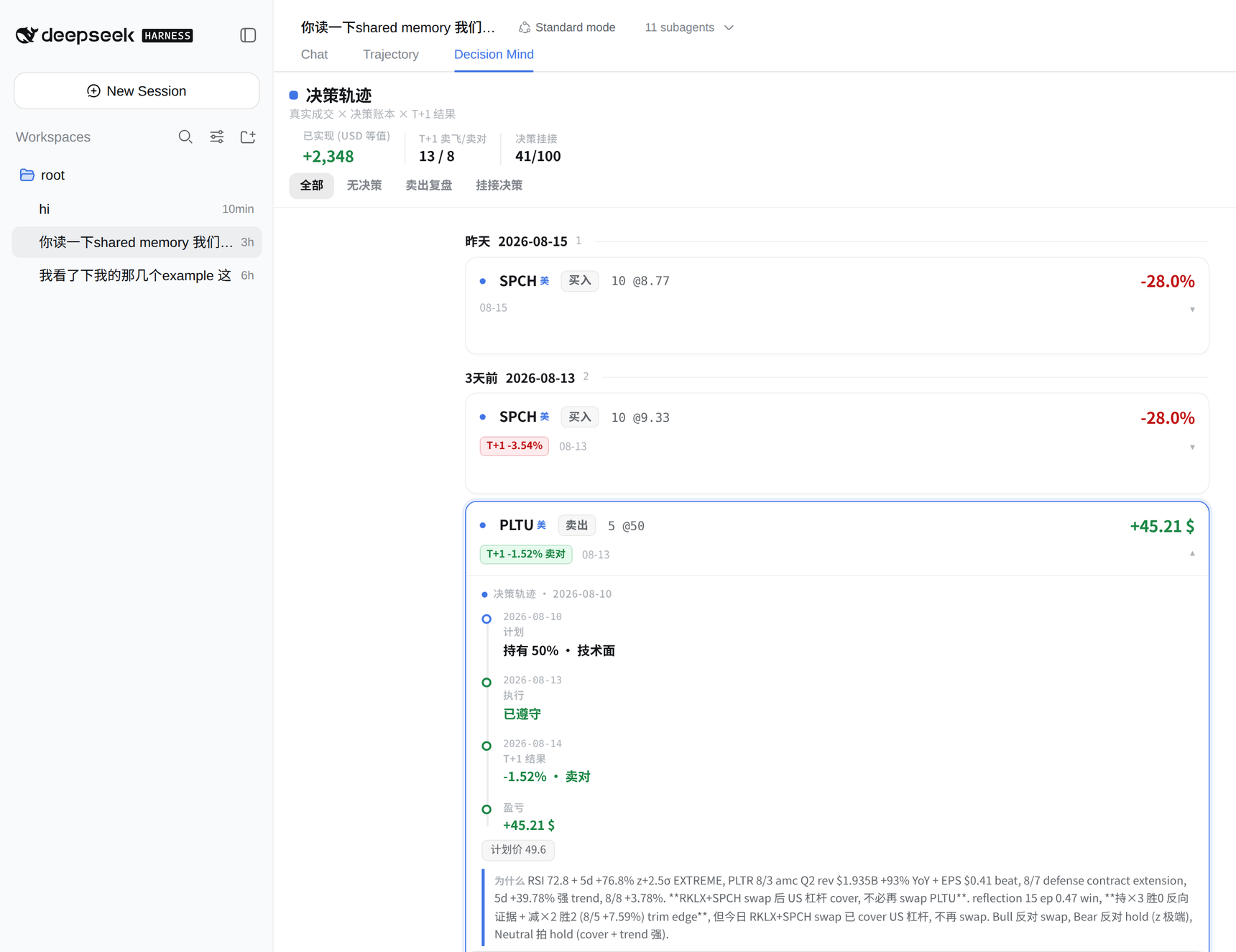
dsh plugin --profile web add clawock-dshThe Decision Mind tab is one view, not three tabs: the spine is your real
fills (portfolio.json trades), each row carries the soft-paired decision
(±3 days from decisions.jsonl) as the "why", and the T+1 snapshot close
decides 卖飞/卖对 on sells. Click a fill and the trace unfolds — plan →
execution → T+1 → P&L — with the rationale and note in semantic colors, plus
an emotion-pressure field on the small number of records that logged one so
far. Fills with no decision say so explicitly, instead of making one up.
Currency is never mixed: USD and HKD stay apart and only combine through the
desk's published FX rate. The same trace data powers the public dashboard's
Reflect card, so the plugin and the website render one contract:
Conversation verdicts land in the same ledger through one command from any
harness: clawock record --source <harness> (bear case and invalidation
conditions mandatory, emotion pressure self-reported). Nobody edits
decisions.jsonl by hand — one ledger, one record command, every harness
calls it.
For the KCNyu compatibility surface, clawock doctor, clawock context audit,
and CLAWOCK_WORKSPACE still inspect or point at an operational book. They name
missing capabilities instead of pretending every foreign workspace is ready to
run this live desk.
The package owns lifecycle implementation, strategies, scheduling, watchdogs,
generation-pinned artifacts, context assembly, validation and CLI. It does not
reimplement an agent loop: OpenClaw is the unattended runtime used by this desk
today, while another runner can consume the same context/tool contracts. The
kcnyu profile and workspace declare this desk's books, resources and schedules;
doctor and context audit state those capabilities instead of pretending every
foreign workspace is production-ready.
| Question | Entry point | Data/runtime contract | Reuse scope |
|---|---|---|---|
| Analyze a US company | us-stock-analysis |
Local quote fallback, SEC filings, fundamentals, news | Reusable with the clawock workspace |
| Analyze a Hong Kong company | hk-stock-analysis |
Tencent/Eastmoney quote checks, HK fundamentals, market context | Reusable with the clawock workspace |
| Review the current portfolio | portfolio-risk-review for one pass; portfolio-swarm-review for debate |
portfolio.json, fresh quotes, risk and decision ledgers |
Specific to the configured portfolio |
| Stress-test a supply-chain thesis | serenity-skill |
Current public evidence plus its local scorecard | Reusable as a manual research framework |
| Review a reported quarter and hold management to account | earnings-review |
First-party filings/HKEX announcements, structured XBRL or Eastmoney verification, provenance gate | Reusable; artifacts live in memory/earnings/ |
| Decide whether a new name is worth researching | entry-gate |
Workspace quote pipelines, instrument registry, evidence source grading, deterministic hard vetoes | Reusable; artifacts live in memory/entry-gates/ |
These surfaces chain in one direction — entry gate, then first-party earnings evidence, then the canonical thesis and its evidence-only drift, then the existing decision, risk and settlement loop. Each step writes a versioned artifact the next one reads, so a later stage can never quietly re-derive an earlier one from prose.
These are workspace-native research routes, not standalone one-command products. They expect clawock's scripts, data contracts, and memory/SOP files; the published portfolio and its operating history remain specific to this deployment.
Built with Claude Code, the openclaw cron daemon, a static Jekyll + GitHub Pages frontend, and Python. Market, news, macro, and sentiment come from documented public sources with multi-source fallback; see third-party data and service terms before reusing any fetched content.
Models. Model selection belongs to the external runtime, not clawock. The live OpenClaw instance can pin a primary and fallback independently for each scheduled job; provider credentials and routing policy stay outside this public repository and can change without rewriting the workflow. No provider key is stored here.
Write reconciliation. Dashboard outputs are one derived generation published on the data plane, while scan sidecars and other runtime state have their own producers. The rule: isolate scan-sidecar writers, serialize dashboard builders that share a host, and keep one publication implementation.
flock; every builder runs the same semantic-diff helper, so clock-only rewrites are restored and the complete generation is published together to the data plane.ops/publish/safe_push.sh — rebase-retry, abort on a real conflict, and a committed conflict marker is rejected at the push hook so a broken generation can never reach Pages.portfolio.json — the single source of truth — is written under an advisory flock with read-fresh-then-overlay and atomic replace. A pre-push hook blocks any push whose book fails a money-conservation identity (TCV = Σ value, cash = baseline + trades + adjustments, cost = moving-weighted), and those derivations are pinned by a pytest suite in CI.| Path | Owner |
|---|---|
src/clawock/ |
Complete product: harness, strategies, scheduling, providers, workflows, schemas and CLI |
config/profiles/ |
Declarative desk profiles; values and resource references only |
site/ |
Jekyll/dashboard source, browser code, SVGs, screenshots and social assets |
ops/{host,publish,ci,growth,pages}/ |
Explicit host, publication, CI, growth and Pages wiring; never a generic data bucket |
docs/, tests/ |
Product/runbook documentation and invariant checks |
root context files, skills/, memory/ |
OpenClaw compatibility surface; kept at runtime-required paths |
portfolio.json, assets/data/ |
Live ledger and generated publication state; never package contents |
LICENSE, NOTICE, THIRD_PARTY_LICENSES/ |
Standard legal/package entry points copied by Pages staging |
This repository holds real trading positions. It is a personal record and portable workspace — not investment advice, a recommendation, or a copy-trading system. The desk analyzes and proposes; it does not place orders for you. No individual outcome is hand-picked — settlement rules and methodology changes are versioned in code — the active calls have yet to show an edge, and every number may be stale by the time you read it.
Original code is under the MIT License. Adapted third-party code keeps its own license and attribution in NOTICE and THIRD_PARTY_LICENSES/. Third-party market data, news, social posts, filings, trademarks, and API access are not relicensed by MIT — see Third-party data and services.
CLASSIFICATION EVIDENCE
系统优先读取 GitHub Topics,再与站内分类词典和词根规则比对。
leozou320-ai
Voice-to-text for the DeepSeek Harness Web UI — live, editable, never auto-sends. | DeepSeek Harness 网页语音输入
lhenlihai-hub
该仓库暂未提供项目说明。
misterbig5222-oss
DeepSeek Harness highlight annotation plugin: 8-color text highlighting, notes, tags, copy/delete, and context-positione…