其他
技能
dsh-web-search-ddg
aooyoo
Zero-token DuckDuckGo search provider for the DeepSeek Harness (DSH) web seam — local headless browser, no API key, no m…
deepseek-harnessdeepseek-harness-plugindsh-bundledsh-ctest
PROJECT TOPICS
PROJECT README
English | 中文
See every agent step. Understand every token.
DSH TraceLens is a visual execution explorer for DeepSeek Harness. It turns the currently loaded Session into an interactive map of user input, model responses, Tool calls, system activity, failures, and per-call Token usage without adding another event store or changing the agent loop.
TraceLens is built for developers who need to understand why an agent behaved the way it did. Follow the execution path as it grows, compare Token costs across model calls, and inspect the exact context behind any node from one navigable canvas.
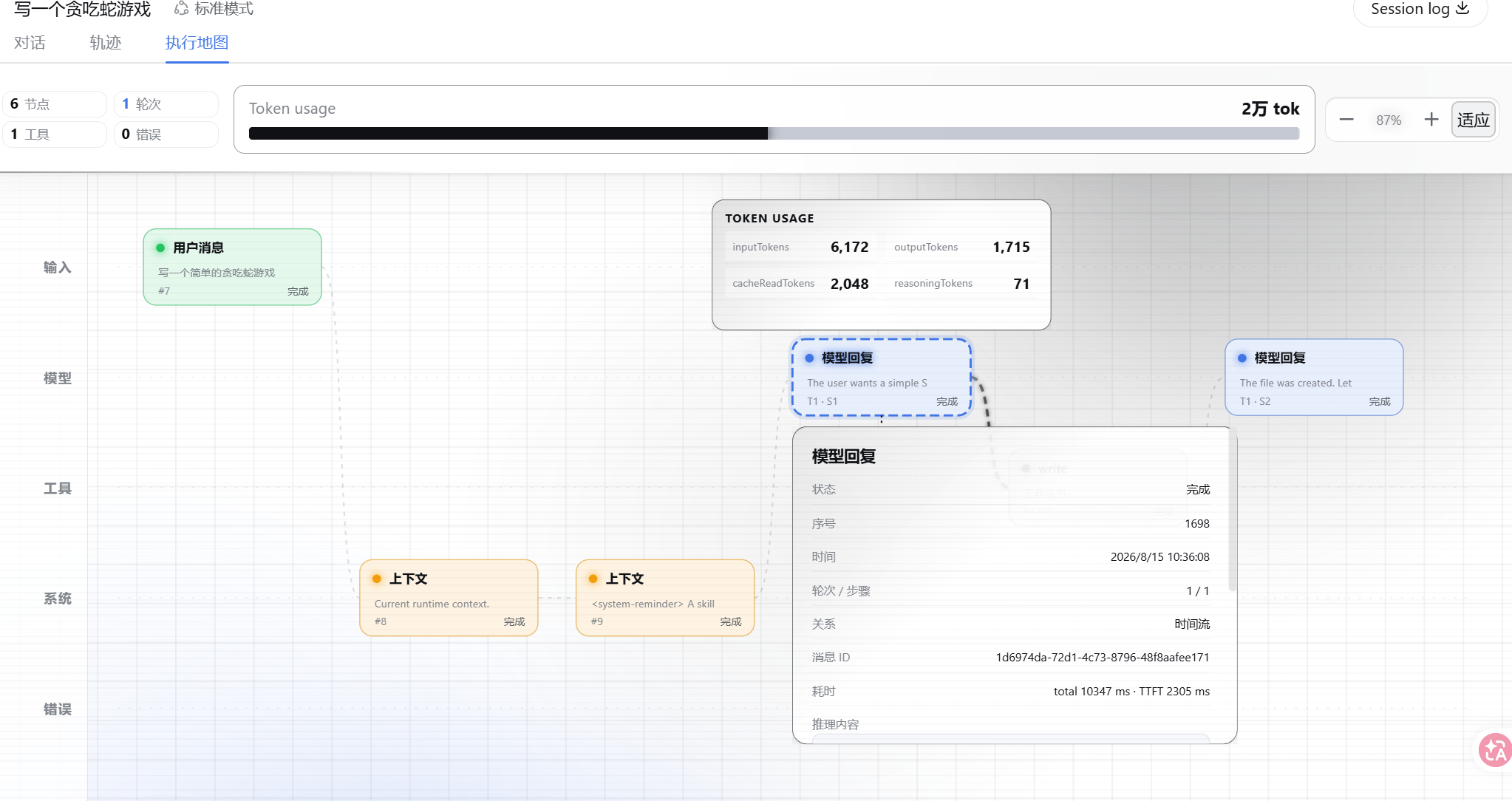
The Agent Map view sits beside the existing conversation views and updates as the Session runs. Five stable lanes separate Input, Model, Tool, System, and Error records. Select any node to inspect the data already recorded for that event, including message content, model request details, reasoning, Tool arguments and results, timing, errors, retries, and nested calls when available.
Model usage is summarized in a conversation-wide 100% stacked dashboard. Selecting a model node highlights its matching segment and opens a four-metric Token card for input, output, cache-read, and reasoning usage. Recorded callId values connect model Tool requests to their results; ordinary adjacent records remain timeline-only relationships.
conversation.view slot and follows the host theme, locale, disposal, and reduced-motion behavior.Prerequisites: Node.js ^22.19 or >=24, pnpm, and a DeepSeek API key for live model execution.
git clone https://github.com/BLueMooneer/dsh-tracelens.git
cd dsh-tracelens
pnpm install
pnpm run build
pnpm dsh web
Open http://127.0.0.1:3080, create or open a Session, then select Agent Map. The map also renders keyless fixture Sessions used by the assembled Web tests.
For operation and troubleshooting, read the Agent Map user guide. For implementation details and extension rules, read the plugin README.
DSH TraceLens remains inside DeepSeek Harness's plugin architecture:
Session projection
      ↓
pure graph projection
      ↓
Agent Map client plugin
      ↓
conversation.view slot
      ↓
DSH Web UI
The graph model and layout are pure functions. React owns only live view state such as selection, fit/manual scale, and viewport position. The plugin adds no host service, persistence format, model-visible input, or second conversation projection.
The main implementation lives in packages/client/ui-agent-map. Web-profile composition is declared by packages/bundle/web-app.
Run focused Agent Map checks from the repository root:
pnpm exec tsc -p packages/client/ui-agent-map/tsconfig.json --noEmit
pnpm exec vitest run packages/client/ui-agent-map/tests
pnpm --filter @deepseek-ai/dsh-client-ui-agent-map bundle
pnpm run build:web
Repository-wide documentation and integration changes must also satisfy the applicable DeepSeek Harness checks described in AGENTS.md.
DSH TraceLens tracks the developer-preview DeepSeek Harness codebase, which can introduce compatibility-breaking changes. The current implementation is an integrated Web-profile fork rather than a separately versioned npm plugin.
Built on DeepSeek Harness and Cordis. Upstream community and contribution guidance remains available in the DeepSeek Harness repository.
MIT. Third-party dependencies and their licenses are listed in THIRD_PARTY_NOTICES.md.
CLASSIFICATION EVIDENCE
系统优先读取 GitHub Topics,再与站内分类词典和词根规则比对。
aooyoo
Zero-token DuckDuckGo search provider for the DeepSeek Harness (DSH) web seam — local headless browser, no API key, no m…
awa-123-cw
DSH 图片/音视频托管插件:自动拉起 8899 静态服务 + 3080 /files/ 路由(HTTP Range 流式)+ WebUI 内点击即播(视频静音/音频 20% 音量/互斥懒加载)
awa-123-cw
DSH 设置页「关于」栏位 + 一键检测更新插件(About page with update checking for DeepSeek Harness WebUI)