其他
技能
dsh-web-search-ddg
aooyoo
Zero-token DuckDuckGo search provider for the DeepSeek Harness (DSH) web seam — local headless browser, no API key, no m…
deepseek-harnessdeepseek-harness-plugindsh-bundledsh-ctest
PROJECT TOPICS
PROJECT README



A standalone dsh (DeepSeek Harness) plugin bundle porting the omp "advisor" subsystem: a per-session independent reviewer model that observes the primary transcript, reviews each stepped turn with an explicitly configured model (provider + model are required), and injects severity-ranked advice (nit / concern / blocker) back into the session — without polluting or recursively reviewing itself.
Advisory only. The advisor never approves or rejects the primary agent's actions, and never issues commands as if it were the primary agent. Every delivered message is self-described advisory content, and a misbehaving reviewer is bounded end to end (emission guard, immuneTurns cooldown, failure policy) so it can never stall or pollute the primary loop.
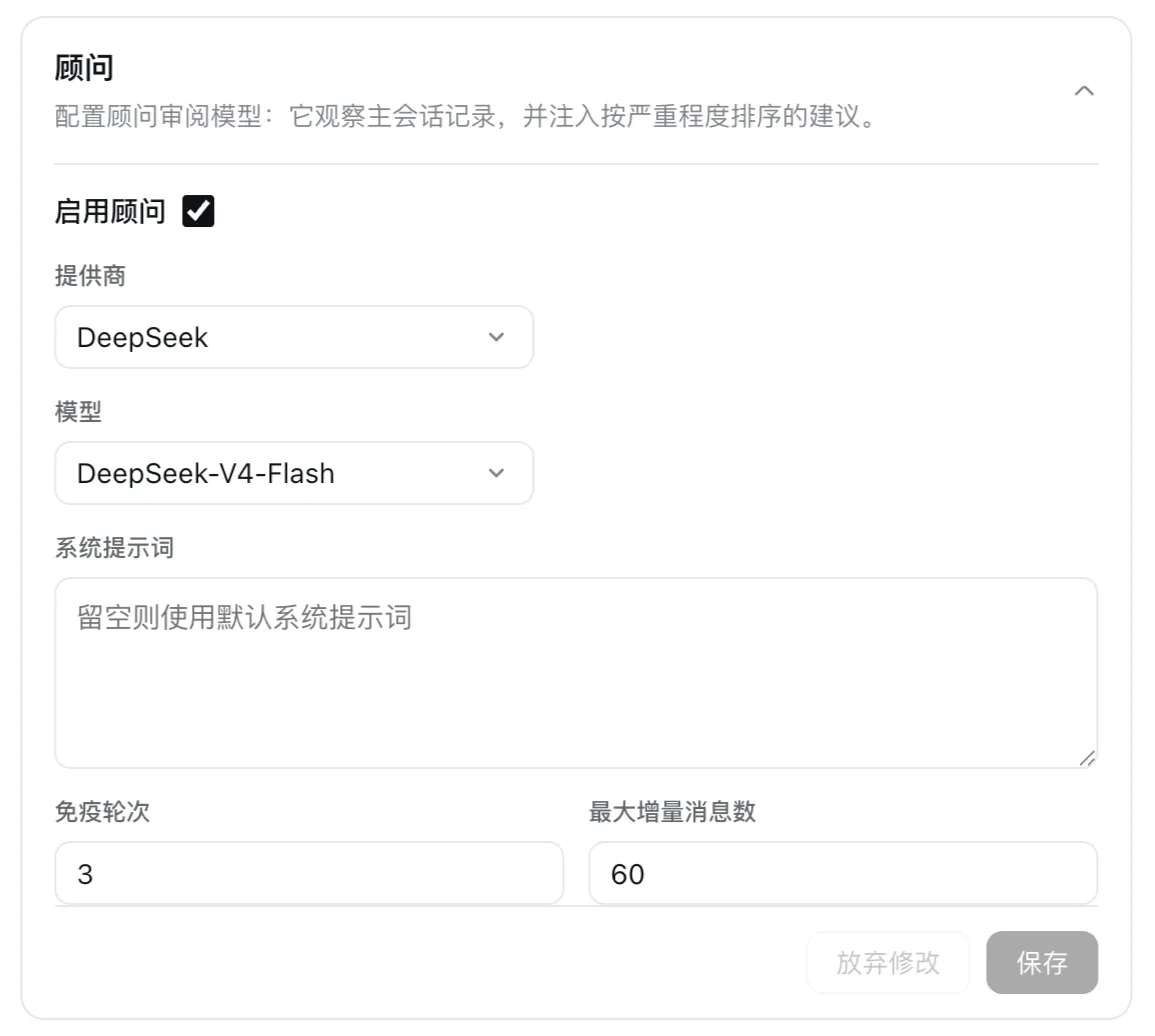
Works in both dsh front ends: the web profile (Settings → 插件配置 → Advisor card) and the dsh-tui terminal profile (/advisor + /advisor config).
dsh plugin --profile web add dsh-advisor      # web profile (Settings → Advisor card)
dsh plugin --profile dsh-tui add dsh-advisor  # dsh-tui terminal profile
Same plugin, either front end — the only difference is the --profile flag. Pin a version with @<version> (e.g. dsh-advisor@0.1.0). A registry install fetches the published tarball, which ships the built artifacts (lib/ + cordis.patch.yml) — nothing builds on the target machine, and runtime dependencies (@deepseek-ai/cordis, @deepseek-ai/schemastery, @deepseek-ai/dsh-* peers) resolve through the dsh installation's flat profile module fallback — no extra install step. Registry / git / tarball / local-directory variants (local-dir from a built checkout: dsh plugin --profile web add . or dsh plugin --profile dsh-tui add .), web Settings exposure, uninstall, and --dump-config verification → docs/install.md.
Add an advisor: section to the global dsh settings document (default $DSH_HOME/settings.yaml — shared across profiles; the web Settings card writes to this same file):
advisor:
  enabled: true                # master switch (default false) — set explicitly to enable
  provider: deepseek-official  # REQUIRED when enabled
  model: deepseek-v4-flash     # REQUIRED when enabled
  systemPrompt: ""             # optional; "" = built-in reviewer prompt
  immuneTurns: 3               # int ≥ 0, default 3 — cooldown after a delivered steer
  maxDeltaMessages: 60         # int ≥ 0, default 60 — delta window; 0 = unbounded
The advisor is off by default. When enabled, provider and model are mandatory: enabled: true without both is a hard gate — the advisor never starts a model call and reports a disabled-with-reason status; unknown config keys are rejected.
The same keys compose across three surfaces (later layers override earlier ones; every surface shares the same key set and the same hard gate, with the host-side gate as the final line of defense on every path):
$DSH_HOME/profiles/<profile>/cordis.patch.yml). This is the composition base.advisor) with the enabled toggle, provider / model selects restricted to system-configured providers and their models, and the optional fields. Saving writes into the advisor settings namespace and applies to new sessions immediately — no restart. The card requires a current dsh web build whose shell declares the settings.plugin.item card slot and loads packages that declare dsh.client; it reads and writes the namespace through the official GatewayService RPC channel (/api/advisor/get + /api/advisor/set), which is not gated by the settings exposure allowlist. It additionally blocks saving while enabled with a required field empty./advisor command — per-session and ephemeral: it flips a session override, never the persisted config (see Verify).In a dsh-tui profile there is no settings page: the same two persisted surfaces (profile patch layer + global $DSH_HOME/settings.yaml) compose the config, and /advisor config prints the composed config as a read-only readback with edit hints. Full reference → docs/configuration.md.
dsh --profile web --dump-config # shows a "# == dsh-advisor" layer with the advisor rowWith the advisor installed and enabled, control it in-session with the /advisor command (available when a command registry is composed):
/advisor            toggle the advisor for this session
/advisor on         enable the advisor for this session
/advisor off        disable the advisor for this session
/advisor status     show state, model, runtime status, pending count, last activity
/advisor on|off|toggle are session-scoped and ephemeral: they flip a per-session override, never the persisted config. Enabling a session whose config lacks provider/model starts no model call — /advisor status (and the /advisor on reply) shows the gate reason: the advisor runs only when enabled with both configured. /advisor on is also the manual recovery path: a session advisor paused by a quota/rate-limit (quota_exhausted — no auto-resume timer) resumes in place, and a halted advisor (permanent model error, e.g. invalid credentials) is rebuilt fresh for the session.
In a dsh-tui profile, /advisor config additionally reads back the composed configuration — read-only, with edit hints: the web Settings card is web-only, and the TUI has no settings page and no write command, so edit through the profile patch layer or $DSH_HOME/settings.yaml. The /advisor / on|off|status|config commands are listed in the TUI / menu with subcommand completion (command discovery requires the dsh-tui-command-trees row — the shipped dsh-tui bundle has it).
Independent reviewer per session: a separate model call observes the primary transcript and reviews each stepped primary turn; advisor messages are excluded from later deltas, so the advisor never reads its own advice back.
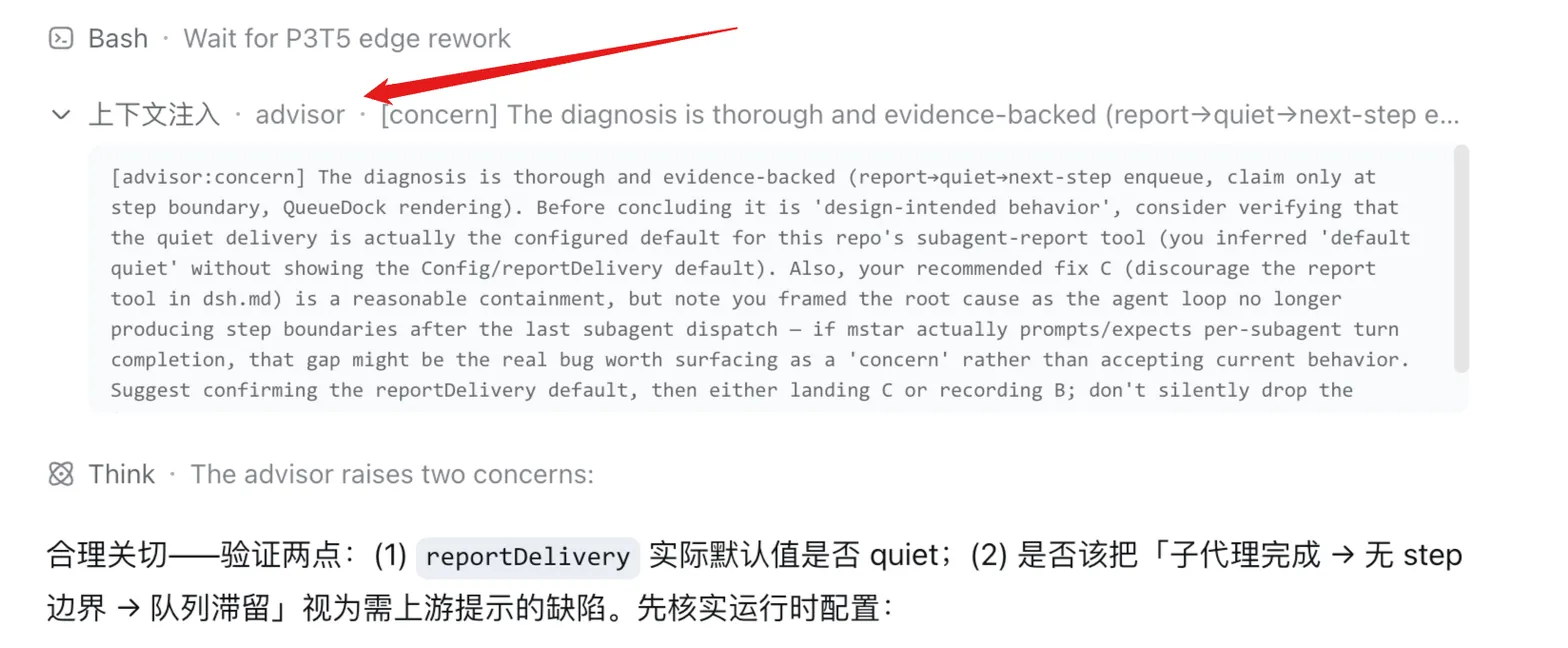
Severity-ranked advice with inject/steer semantics: at most one note per review — nit (a minor style, clarity, or quality suggestion; delivered via non-waking agent.inject, consumed at the next pre-step boundary), concern (a material risk or clearly better direction to weigh before continuing; delivered via waking agent.steer, subject to the immuneTurns cooldown), blocker (continuing clearly wastes work — contradicts an explicit user instruction, going in circles, fundamentally unsound; delivered via agent.steer). Delivered messages carry the [advisor:{severity}] prefix and are self-described advisory content:
[advisor:concern] extract the helper into a module and unit-test itExplicit model gate: enabled defaults to off; enabled: true without provider + model never starts a model call — status reports disabled-with-reason. Unknown config keys are rejected.
Zero-tool minimal start: the reviewer is an independent model call only — no advisor tools, nothing it can do to the session besides advisory messages.
No-stall failure policy: a failing or quota-limited advisor only drops its own bounded backlog — it can never park or pollute the primary loop.
Session-scoped controls: /advisor on|off|status|config work per session; the toggles are ephemeral overrides, never persisted config.
The plugin installs as a pure mount: bundle insert + client card (web Settings 插件配置) + its own gateway channel (/api/advisor/get|set, claimed by the host's typertGateway — the same mechanism the dsh goals service uses, not gated by the settings exposure allowlist) + the /advisor commands — no dsh patches, no postinstall step, and dsh upgrades never require re-patching.
The MVP deliberately drops full omp parity. Accepted gaps (tracked in the harness iteration roadmap):
syncBacklog catch-up wait — a far-behind advisor does not wait for the primary loop; its backlog is bounded and dropped, so notes may arrive after the next primary turn started (roadmap: context-maintenance batch).maxDeltaMessages), so the advisor may lose early context after compaction (roadmap: next-next iteration).| Doc | Content |
|---|---|
| docs/install.md | profile install (web + dsh-tui) / registry / git / tarball / local-directory variants / web Settings exposure / uninstall / --dump-config verification |
| docs/configuration.md | full advisor namespace reference: keys & defaults, explicit model gate (S4), settings surfaces (web card / patch layer / global settings.yaml), example YAML, live re-apply behavior |
| docs/consumer-api.md | developer consumption contract: package-root library API, dsh-advisor/client entry, /advisor command surface, export inventory, lifecycle |
| docs/verification.md | verification records: test matrix (16 files / 319 cases), typecheck/build, CI contract, real-environment steps |
| docs/release.md | release process: PR-driven Release prep + Release workflows, OIDC trusted publishing, version strategy, rollback |
Released under the MIT License — see LICENSE. The LICENSE file is authoritative for copyright and license terms.
CLASSIFICATION EVIDENCE
系统优先读取 GitHub Topics,再与站内分类词典和词根规则比对。
aooyoo
Zero-token DuckDuckGo search provider for the DeepSeek Harness (DSH) web seam — local headless browser, no API key, no m…
awa-123-cw
DSH 图片/音视频托管插件:自动拉起 8899 静态服务 + 3080 /files/ 路由(HTTP Range 流式)+ WebUI 内点击即播(视频静音/音频 20% 音量/互斥懒加载)
awa-123-cw
DSH 设置页「关于」栏位 + 一键检测更新插件(About page with update checking for DeepSeek Harness WebUI)