





Agent 与会话
插件
dsh-thinking-language-zh
ayanJava111
deepseek harness思考过程中文插件
chinesedeepseek-harnessdsh-pluginprompt
PROJECT TOPICS
PROJECT README
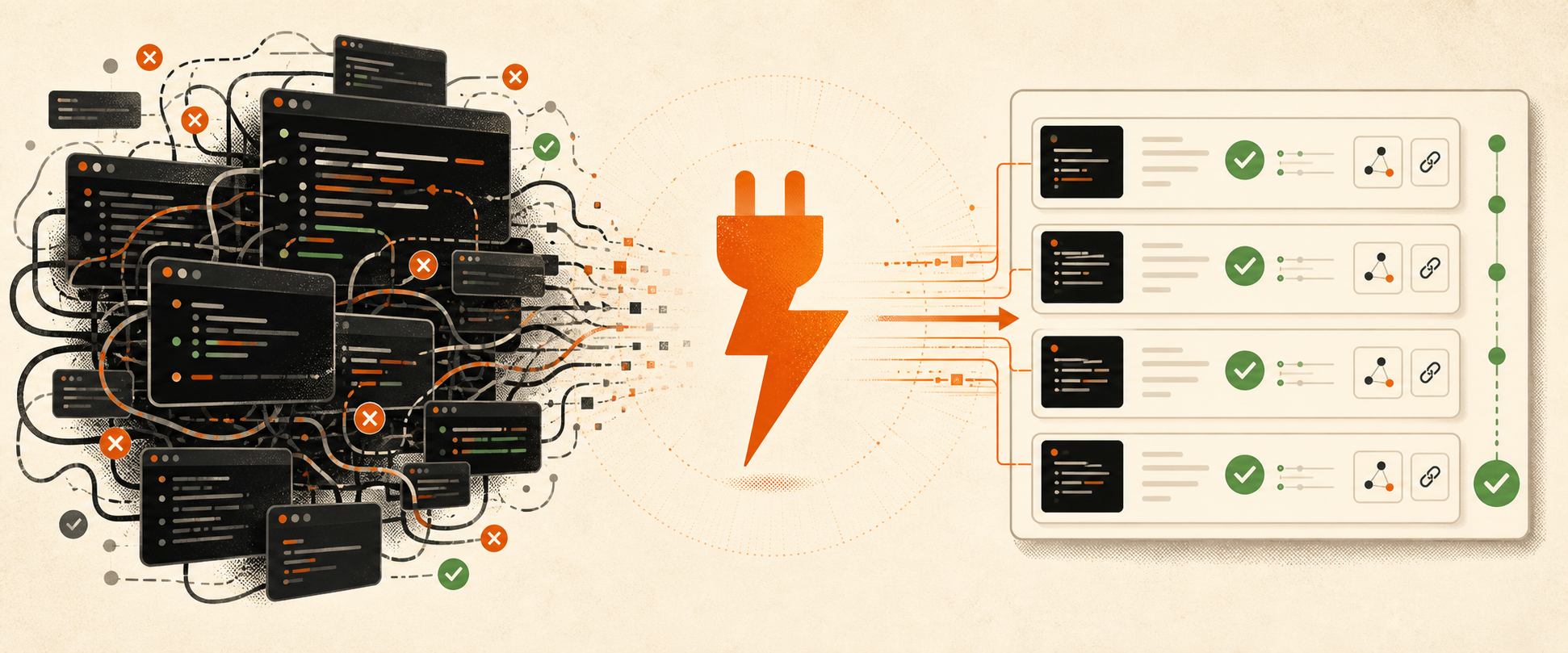
A DeepSeek Harness plugin that reads the session log DSH already writes and hands the agent a short, cited ledger of what has actually worked in this workspace — the commands that succeed, the ones that reliably fail, and the variant that fixed them.
No capture step. No index to build. No model to download. It works on sessions recorded before you installed it.
Every new session, your agent starts from zero in a codebase it has already worked in for weeks.
It runs npm test in a Bun repo. Again. It re-greps the same three files to find where routes live. Again. It hits the same build error you already walked it past on Tuesday, and you type the same correction you have now typed four times.
None of this is a memory problem in the usual sense. The information was never lost — DSH appends every message, tool call, tool result, and failure to a durable log on disk. What's missing is anything that reads it back.
Two things quietly widen the gap:
shadowed. The agent cannot see them anymore. The file still can.web profile mounts session-query-sqlite with openAt: never, so full-text search calls fail with SESSION_QUERY_SEARCH_DISABLED and the sidebar matches session titles only. Months of transcripts sit on disk, unsearchable, by default.Reads — walks this workspace's sessions through ctx.sessionQuery exact reads, pairs every tool/call with its tool/result, and keeps the outcome.
Distills — aggregates that into a ledger: command → runs, failures, last success, and the repair (the variant that succeeded right after a failure in the same session). This step is arithmetic, not summarization. No LLM in the extraction path, so it cannot hallucinate a precedent.
Serves — injects the top entries as one compact, prefix-stable system-prompt section, and prints the full ledger on /precedent.
Every line carries a citation back to the exact session:seq that produced it, so you can always ask "says who?" and get an answer.
Launch as usual:
$ dsh --profile webThe agent's system prompt gains one section — this is the renderer's real output, with commands that never work sorted above commands that always do:
## Precedent for /Users/thor/Github/acme-api

Observed in this workspace (12 sessions, 2026-06-02 → 2026-08-15). Each line is counted from the session
log, not summarized — treat it as evidence, not instruction.

- `npm test`            4 runs, 4 failed     — repaired by `bun test`  [s/7f3a:212]
- `docker compose up`   3 runs, 3 failed     — no known repair  [s/91bc:88]
- `bun test`            22 runs, 0 failed    — last ok 2026-08-15
- `bun run build`       9 runs, 0 failed     — last ok 2026-08-14
/precedent prints the same ledger uncapped, on demand.
dsh plugin --profile web add 'github:dshplugin-me/dsh-precedent#v0.1.0'No global dsh on PATH? Use npx -y @deepseek-ai/dsh plugin --profile web add …. Running dsh from a source checkout? Use pnpm dsh plugin … from the checkout root. Replace web with whichever profile you actually launch.
Pinning the version is deliberate: an unpinned git install resolves to whatever main points at right now, so a later push silently changes what is mounted in your profile. A commit sha (#<sha>) works too, and not even a maintainer can move that.
Pure JavaScript, no build step, no native module, no allowBuilds prompt.
Verify before launching:
dsh --profile web --dump-config   # look for the "# == dsh-precedent" layer
dsh --profile web
Remove with dsh plugin --profile web remove dsh-precedent, which takes the patch layer and the dependency together.
flowchart LR
  log[("Session log<br/>~/.dsh · JSONL")]
  sq["ctx.sessionQuery<br/>exact reads"]
  led["Ledger<br/>pure aggregation"]
  sp["ctx.systemPrompt<br/>.section()"]
  cmd["ctx.commands<br/>/precedent"]
  model(["Model"])
  you(["You"])

  log --> sq --> led
  led --> sp --> model
led --> cmd --> you| Harness surface | Used for | Notes |
|---|---|---|
ctx.sessionQuery.filterSessions |
Select this workspace's sessions | Filtered by cwd, the same conservative scope DSH's own cross-session tool uses |
ctx.sessionQuery.readSession |
Read one session's raw event log | Replay-validated; an unreadable log is skipped, never fatal |
ctx.systemPrompt.section |
Inject the ledger | One global section at order 150, rendering with tool guidance |
agent/pre-step |
Warm the ledger before the first request | Awaited waterfall — the only hook that runs before prompt assembly |
ctx.commands.register |
/precedent |
Human surface, never sent to the model |
Pairing happens inside readSession's event array: a tool/call with name: 'bash' is matched to its tool/result by callId, and the result's error field (or the result block's isError) decides the outcome.
ctx.sessionQuery splits into two halves. Full-text search (searchSessions, searchEvents) needs a provider and is off in the shipped profile. Everything else — listSessions, filterSessions, readSession, listEvents, readEvent, lineage and event traces — is backend-independent concrete behavior that works whether or not a search backend is open.
dsh-precedent uses only the second half. That is the whole reason it needs no index, no embedding model, and no warm-up: it reads the log the way the harness itself reads it for resume and export.
The cost is honest and bounded: a ledger build is a linear pass over this workspace's logs, done once per workspace per process, capped at maxSessions, and it stops blocking the first step after buildTimeoutMs whether or not it has finished.
A command either exited non-zero or it didn't. tool/result.error records which. Pairing it to its tool/call by callId and counting is arithmetic — deterministic, reproducible, and impossible to hallucinate.
The one place judgment is genuinely required is deciding whether a user correction is a durable convention ("use bun, never npm") or one-off steering ("no, the other file"). That is why v0.1.0 ships no correction mining at all: the command ledger stands on arithmetic alone.
- id: precedent
  name: dsh-precedent
  config:
    maxEntries: 40        # ledger lines injected per session
    minRuns: 2            # ignore commands seen only once
    lookbackDays: 90      # ignore sessions older than this
    maxSessions: 200      # upper bound on logs read in one build
buildTimeoutMs: 5000 # stop blocking the first step after this| Key | Default | Meaning |
|---|---|---|
maxEntries |
40 |
Hard cap on injected ledger lines, so the section stays a fixed, small token cost. /precedent is never capped |
minRuns |
2 |
A command seen once is an anecdote, not a precedent |
lookbackDays |
90 |
A convention from six months ago may no longer be true |
maxSessions |
200 |
Newest sessions first; a workspace with years of history stays cheap to read |
buildTimeoutMs |
5000 |
A slow build releases the first step and lands on a later one instead |
Scope is not configurable: sessions are matched on exact cwd string equality, the same conservative rule DSH's own cross-session authorization uses — a symlinked path is a different workspace.
| Command | What it does |
|---|---|
/precedent |
Print the full ledger with citations, uncapped |
/precedent rebuild |
Discard the cached ledger and re-scan |
Everything the plugin injects is visible on demand before you trust it. A memory you cannot audit is a memory you cannot trust.
AGENTS.md. Hand-written intent still wins. Precedent covers the part nobody keeps up to date: what actually happened.ctx.sessionQuery and holds the ledger in memory. No files written, no network calls, no telemetry, no upload path in the code.cwd equality, mirroring the boundary DSH's own tool-session-query enforces. Another project's log is not read, even on the same machine.curl -H "Authorization: …", DEPLOY_KEY=… ./ship). Every command is matched against secret-shaped patterns and the whole entry is discarded — not masked, discarded — before it reaches the ledger./precedent prints exactly what gets injected, with a session:seq citation on every line that came from a failure.| Verbatim search plugins | Note-taking memory plugins | AGENTS.md editors |
dsh-precedent | |
|---|---|---|---|---|
| Works on pre-install history | Yes, after indexing | No — starts empty | No | Yes, immediately |
| Needs an index or model | Usually | No | No | No |
| Acts before you ask | No | Sometimes | Yes | Yes |
| Sources are citable | Yes | Rarely | N/A | Always |
| Can hallucinate an entry | No | Yes | N/A | Not in the ledger path |
| Answers "what did we discuss" | Yes | Partly | No | No |
Different jobs. A recall plugin is a search box; precedent is a track record. Running both is reasonable.
v0.1.0 — command ledger, system-prompt injection, /precedentv0.2.0 — tools/pre-execute advisory on a known-bad call, intercept: warn | ask | deny via ctx.tools.guardv0.3.0 — correction mining with citations, /precedent why, /precedent pin, /precedent forgetv0.4.0 — incremental rebuild as the current session appends, instead of once per processAGENTS.md draft for human reviewInterfaces above are frozen against deepseek-ai/deepseek-harness@47f943859bef (read 2026-08-16). Anything that changes upstream will be noted here rather than silently adjusted.
Issues and PRs welcome. Useful contributions, roughly in order of value:
Part of dshplugin.me · sibling project: dsh-plugin-radar
CLASSIFICATION EVIDENCE
系统优先读取 GitHub Topics,再与站内分类词典和词根规则比对。
ayanJava111
deepseek harness思考过程中文插件
ben7am1n
Durable cross-session SQLite memory for DeepSeek Harness
chenkezhen480
为deepseek-harness添加向量化跨会话记忆插件