
其他
技能
dsh-web-search-ddg
aooyoo
Zero-token DuckDuckGo search provider for the DeepSeek Harness (DSH) web seam — local headless browser, no API key, no m…
deepseek-harnessdeepseek-harness-plugindsh-bundledsh-ctest
PROJECT TOPICS
PROJECT README
Image recognition and image generation for DeepSeek Harness (dsh-plugin, a Cordis plugin).
The plugin is just tools: image_recognize, image_generate, and vision_providers call whichever external API models the deployer declares — vision via multimodal chat/completions; image generation via OpenAI-compatible images/generations or the Aliyun DashScope native async-task protocol. No model is bundled or defaulted — a tool invoked without a configured model fails with a clear, actionable error. It never guesses and never fails silently.
| Image recognition | Image generation |
|---|---|
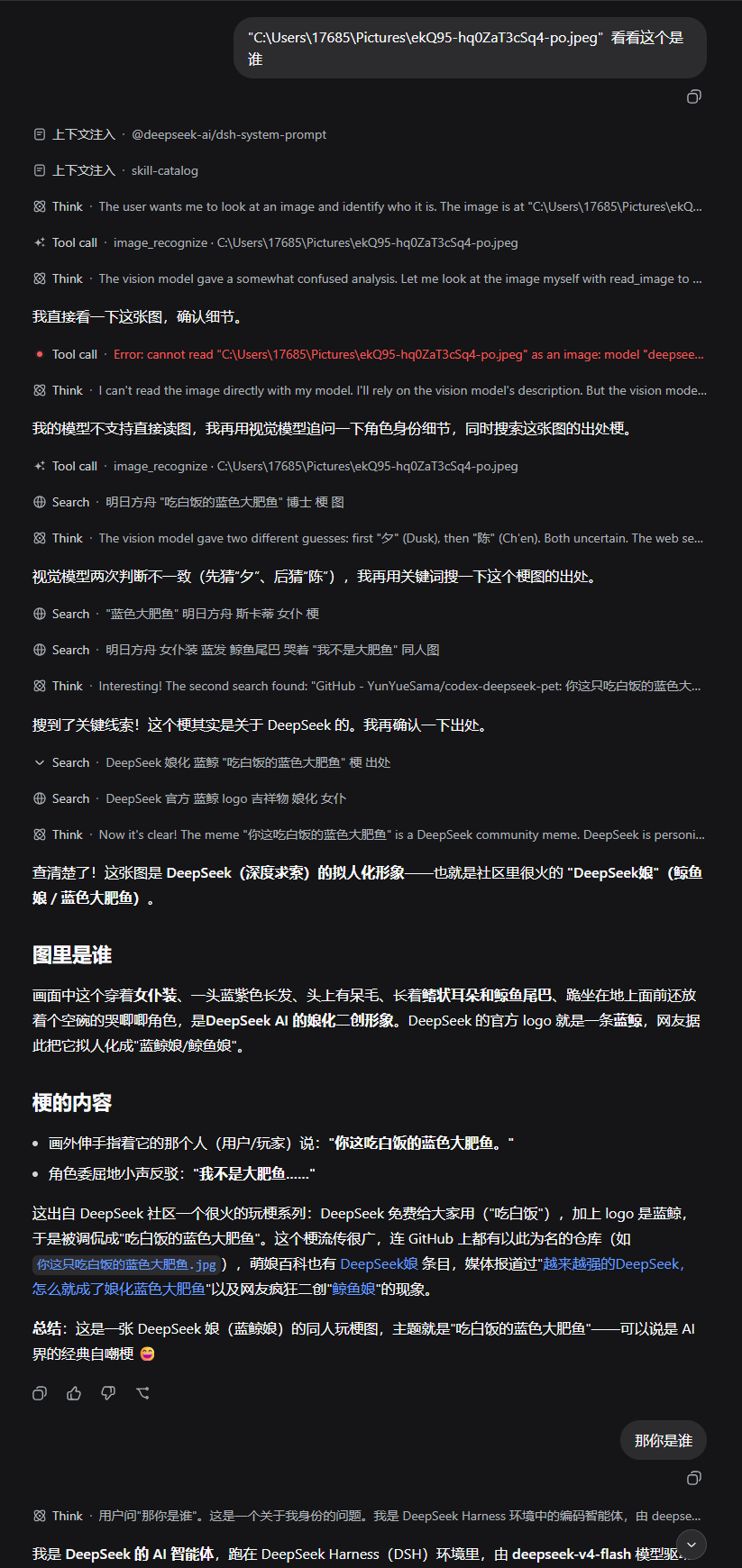 |
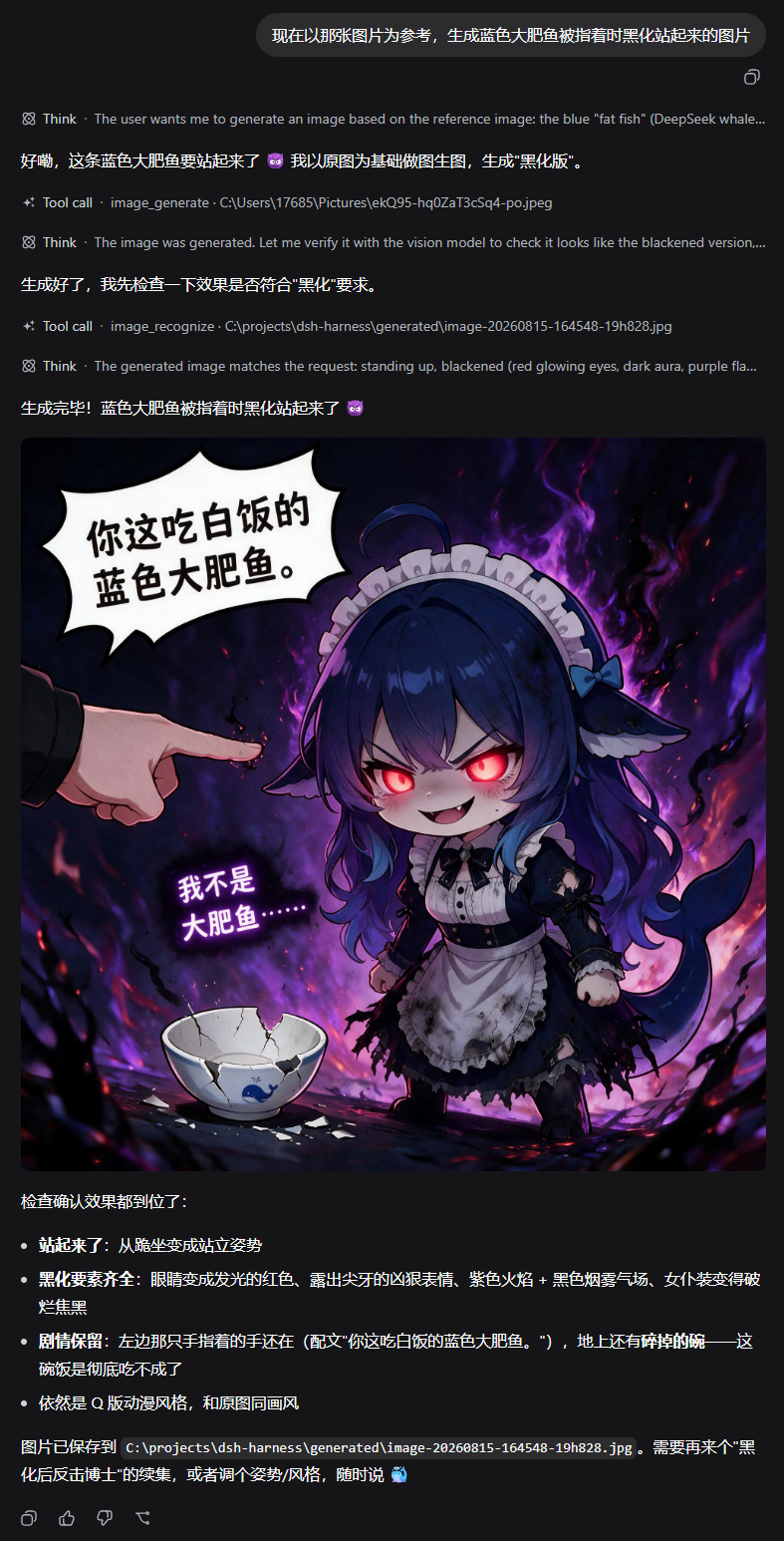 |
image_recognize — analyze an image (local path / http(s) URL / data URI) through a configured vision model: describe, OCR, read charts/screenshots, review content, …prompt (what to ask), max_tokens / temperature, per-call provider selectionimage_generate — generate or transform an image through a configured image model, save it to disk, and return its file path plus a Web-renderable URL when the static server is enabledimages/generations (prefers b64_json, falls back to URL download), or protocol: dashscope-native for the DashScope async task API (submit → poll → download), needed when an OpenAI-compatible gateway exposes no image routes (some Aliyun deployments)image argument (source image) to generate from it (edit / variant / style transfer). OpenAI-compatible endpoints use the image field; DashScope native uses base_image_urlwatermark: false (Doubao Seedream etc. support it; endpoints rejecting the param are retried without it). Set watermark: true on the provider to keep the vendor's mark lines the model can paste into its reply so the GUI renders them (the GUI's Markdown renderer allows only absolute http(s) image URLs — local paths, relative links and data URIs never render; the harness webserver serves no arbitrary files, and writing into the frontend dist directory does not work, tested)size (e.g. 1024x1024), n (1–4, auto-suffixed filenames), output_path (directory or file)<caller workspace>/generated/, timestamped filenamesvision_providers — list every configured external model (id, kind, model, endpoint, apiKey status) so the model can pick a provider idproviders list accepts any number of entries; each tool call may select one via provider, defaulting to the first of the matching kindapiBase, model, or apiKey all raise actionable Chinese errors when the tool is called; missing connection settings never prevent DSH Web from startingThe DSH plugin command delegates installation to pnpm, so pnpm must be on
PATH regardless of how DSH itself is launched. Build this local checkout
before installing it (the package entry point is lib/index.js):
cd C:/projects/dsh-harness/dsh-multimodal
pnpm install
pnpm run build
Then use the command that matches how you run DSH:
# DSH run through npx (no global `dsh` command)
npx @deepseek-ai/dsh plugin --profile web add file:C:/projects/dsh-harness/dsh-multimodal

# DSH run from a deepseek-harness source checkout (run from that repo root)
pnpm dsh plugin --profile web add file:C:/projects/dsh-harness/dsh-multimodal

# DSH installed with a global `dsh` command
dsh plugin --profile web add file:C:/projects/dsh-harness/dsh-multimodal
The package also has a prepare lifecycle script so Git-hosted installs build
before use. A local file: checkout should still be built explicitly before
add, which makes the required runtime artifact easy to verify.
Then restart the Web profile with the same launcher (npx @deepseek-ai/dsh web,
pnpm dsh web, or dsh web) and open a new session (tool sets are fixed
per session). The in-package cordis.patch.yml is the deployment config source
(in-package config overrides outer layers; settings.yaml and user profile
patches only fill undeclared keys).
⚠️ Applying config changes (important): the web profile uses
nodeLinker: hoisted, so afile:plugin is copied into the profile (not symlinked). After editingcordis.patch.ymlyou must resync:
- Delete
<DSH_HOME>\profiles\web\node_modules\dsh-plugin-multimodal(the snapshot dir)- Run
<your DSH launcher> plugin --profile web install- Restart the Web profile with the same launcher
Re-running
dsh plugin addalone will not recopy existing content; deleting the snapshot first is what makesinstallreliable.
Fill in apiBase, apiKey, and model in the providers list of the in-package cordis.patch.yml (none of these connection values has a working default). The plugin and DSH Web still start while they are empty; validation happens when the corresponding tool is called. The protocol is OpenAI-compatible, so any vendor works:
providers:
  # Image recognition: multimodal chat/completions
  - id: my-vision
    kind: vision
    apiBase: https://api.openai.com/v1        # or https://api.siliconflow.cn/v1 etc.
    apiKey: sk-xxxx                            # your API key
    model: gpt-4o                              # or Qwen/Qwen2.5-VL-72B-Instruct etc.
    # maxTokens: 1024      # optional
    # temperature: 0.2     # optional

  # Image generation: ONE provider covers text-to-image AND image-to-image
  # (Volcengine Ark Doubao Seedream uses this protocol too)
  - id: my-image
    kind: image
    apiBase: https://api.openai.com/v1        # or https://ark.cn-beijing.volces.com/api/v3
    apiKey: sk-xxxx
    model: gpt-image-1                         # or doubao-seedream-5-0-pro-260628 etc.
    # i2iModel: doubao-seedream-3-0-i2i-250528 # optional: i2i model used when an
    #                                          #   image arg is passed; omit when the
    #                                          #   model handles both (e.g. Seedream 5.0 Pro)
    # watermark: false      # default false (watermark-free), no need to set
    # size: 1024x1024       # optional default size

  # Image generation: Aliyun DashScope native protocol (use when the
  # compatible-mode gateway exposes no image routes; tested: wanx2.1-t2i-turbo
  # is watermark-free). Aliyun t2i/i2i are separate models → i2iModel.
  - id: my-image-wanx
    kind: image
    protocol: dashscope-native
    apiBase: https://dashscope.aliyuncs.com
    apiKey: sk-xxxx
    model: wanx2.1-t2i-turbo
    i2iModel: wanx-v1                          # i2i model (input image must be a public http(s) URL)
    size: '1024*1024'      # DashScope sizes use an asterisk
id must be unique; the same endpoint may host several models under different ids; vision and image generation may point at different vendors. image_generate does not distinguish t2i/i2i: passing an image argument switches to i2iModel (or the same model when unset); omitting it means text-to-image.
Open a new session and ask: "Do you have image_recognize / image_generate tools?" — or have the model run vision_providers to list the configured models.
image_recognizeimage_generate returns the saved file pathimage_generate with image + providervision_providersDSH Web and the plugin remain available. Only the invoked tool fails, e.g.:
multimodal: provider "my-vision" 未配置 apiBase。请在插件包内 cordis.patch.yml 的 providers 中填写 OpenAI 兼容端点,然后重启 Web profile。| Key | Default | Meaning |
|---|---|---|
providers |
[] at schema level; the bundled patch contains two empty editable examples |
External API models. Each entry: id (unique), kind (vision / image), apiBase, apiKey, and model (required when calling the provider), protocol (image generation only: openai = images/generations (default); dashscope-native = Aliyun DashScope async task API), optional i2iModel / watermark (default false) / size / maxTokens / temperature |
outputDir |
empty (= <caller workspace>/generated) |
Default directory for generated images; relative paths resolve against the caller workspace, absolute paths are used as-is |
staticPort |
3081 |
Built-in static image server port (127.0.0.1); generated images are exposed at http://127.0.0.1:<port>/<file> for the Web GUI to render via markdown. 0 disables it (paths only); port conflicts degrade gracefully |
image_recognize args: image (required: path / URL / data URI), prompt, provider, max_tokens, temperature.
image_generate args: prompt (required), image (optional: image-to-image source, path / URL / data URI), provider, size, n (1–4), output_path (directory ends with / or \).
npm install --cache ./.npm-cache   # build & test deps
npm run build                      # tsc → lib/
npm test                           # unit tests (stubbed API, no network)
node scripts/verify.mjs            # mount check: loads, tools register, error contract
Peer dependencies (@deepseek-ai/cordis, @deepseek-ai/dsh-tools, and @deepseek-ai/schemastery) are also development dependencies for local builds and tests. An installed plugin consumes the compatible peer versions supplied by its DSH profile/runtime.
base_image_url rejects local paths and data URIs (tested). Upload the source image to a public location (Alibaba Cloud OSS / any image host) first and pass the URL. Some models (e.g. wanx2.1-imageedit) are pickier about URLs — wanx-v1 is the most reliable for i2i (tested)response_format; if the endpoint still errors, the remote message is surfacedMIT
CLASSIFICATION EVIDENCE
系统优先读取 GitHub Topics,再与站内分类词典和词根规则比对。
aooyoo
Zero-token DuckDuckGo search provider for the DeepSeek Harness (DSH) web seam — local headless browser, no API key, no m…
awa-123-cw
DSH 图片/音视频托管插件:自动拉起 8899 静态服务 + 3080 /files/ 路由(HTTP Range 流式)+ WebUI 内点击即播(视频静音/音频 20% 音量/互斥懒加载)
awa-123-cw
DSH 设置页「关于」栏位 + 一键检测更新插件(About page with update checking for DeepSeek Harness WebUI)